Once upon a time a friend of mine wanted me to play Persona 5, as it was apparently the best thing since sliced bread or something like that. I had heard of Persona 5 beforehand (If I recall, it was in the first ever copy of GameInformer that I ever received) but didn’t have much incentive to try it, as I already had quite a few things that I was busy doing. However, after much persistence from my friend I agreed on one condition: He complete the 3 main games in the Kingdom Hearts franchise (1, 2 and 3). Said games I also thought were pretty great as I grew up with them, and still have a fondness for them to this day. Following his completion of each game he gave a in depth review of them, including story, gameplay and area rankings (my personal favorite part) and I picked up on that following my completion of Persona 5. Thus, the game trade was born and over the years we’ve subjected each other to games we’d think the other one would like, or in my case, be subjected to some of the most frustrating games in existence that I’ve ever had the displeasure of playing. And that leads us to the most recent iteration, where I have to play Disco Elysium: The Final Cut.
Now, normally we used to have some form of ongoing theme that connected the two games, either loosely or metaphorically. The first game trade (Kingdom Hearts for my friend, Persona 5 for me) had the theme of hearts, emotions and strong bonds. But over time the connections became looser and looser as time went on, to the point where I’m playing as a drunk, washed up detective in not-Greenland while my friend is playing through a game where two siblings have to survive the plague in 1800’s France. So without further ado, the story.
The Story
Disco Elysium starts with one of those old fashioned character creators, as it’s a bit like an RPG akin to things like Dungeons and Dragons in terms of actions. For my first playthrough, I decided to go more for an intelligence build and put my last skill point into encyclopedia (a decision I would later regret). The game begins with a quote
“The furies are at home
in the mirror; it is their address.
Even the clearest water,
if deep enough can drown.”
– R. S. Thomas
To a lot of people, this probably means nothing to them, but I think it’s actually pretty poignant. In Greek Mythology the furies are chthonic deities that are embodiments of vengeance and self loathing. The character you play as, Harry Du Bois has a little profile icon in the bottom left of the screen as most games employ (I’m partial to bottom right HUDs thank you very much) but when you start the game it’s a mere silhouette, as he wakes up from a severe hangover.

But you can change this, looking into a mirror in the bathroom reveals what your character truly looks like, and the result is nothing short of grotesque

You can go the whole game without looking in the mirror by the way, and perhaps that’s what the quote suggests. If the furies live in a mirror (or any reflective surface, like a clear pool of water) you can drown in it, and in Harry’s case, looking into the mirror might show him something he’d rather not see. And I realize I haven’t even started yet, let’s move on.
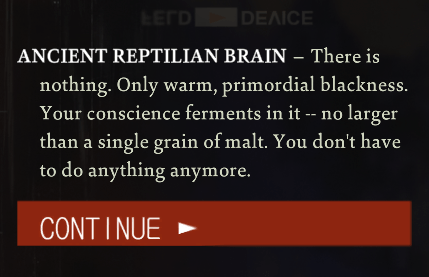
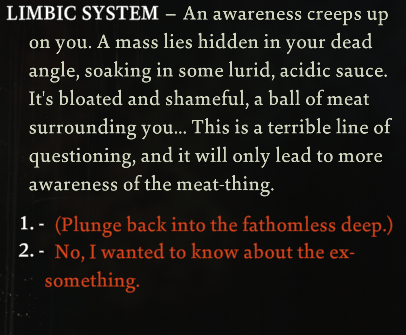
You start by having a conversation with… an Ancient Reptillian Brain and your limbic system, and I’m of course told right off the bat this is going to be one of those weird games. Said aforementioned friend has a lot of wildcards up his sleeve for these trades (to be fair, so do I) and this appears to be one of them. This will likely be a very bizarre experience, but as long as it isn’t a FromSoft game (read: terrible, overcomplicated trash) I’ll take it.
Eventually you’re able to wake up and take control of your character, who wakes up in a hotel room that’s been thoroughly trashed wearing nothing
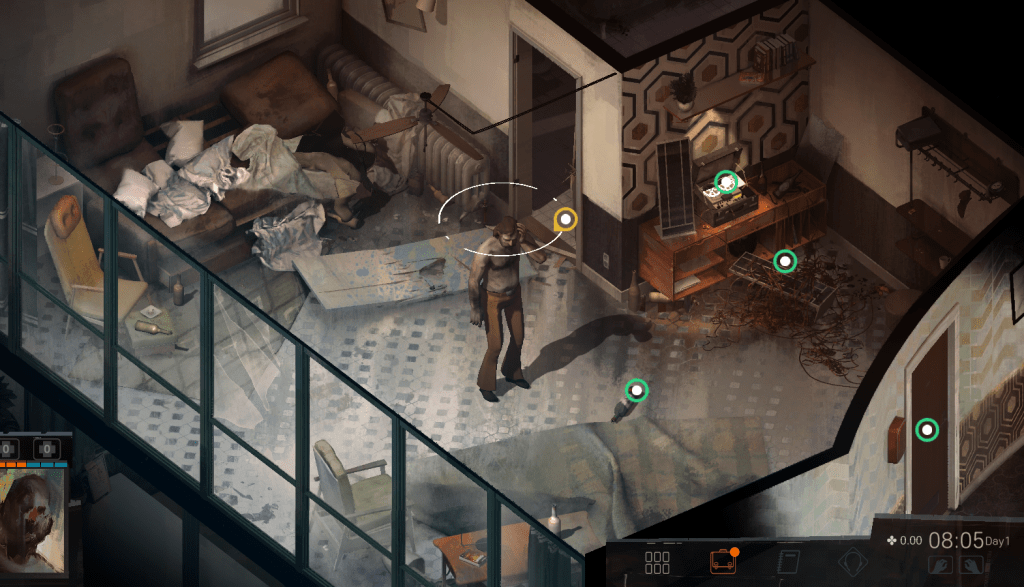
Yeah… Not our character’s finest moments. Scattered around the room you can collect a tie, a green blazer, a undershirt, pants (which you need to pick up) and a shoe (the other one is out on the balcony). And this is one of the game’s main features: your clothes. Throughout the game you’re able to come across numerous articles of clothing that you’re able to wear to provide slight boosts to some of your stats. Some increase stats more than others at the cost of lowering others, or simply raise one or two different stats. Rarely, you’ll come across items locked behind a sidequest, and they’ll likely be what give you the most boosts depending how hard you work for them. But more on that in gameplay. Searching your pockets you find your room key and you stumble out of the room and down the stairs
One of the main things in Disco Elysium is how you interact with other people that you encounter in Revachol. Some are genuinely kind and helpful, while others are belligerent and rude to you, though with some justification in certain cases, such as Garte the bartender, except apparently he gets pretty pissed whenever you call him that.
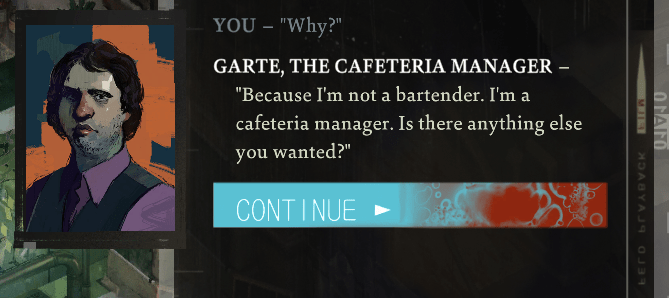
Yeah, you start at the midpoint of Harry Dubois’s stay in Revachol, and have no recollection of what you did on your first few days in town. But that’s okay, we’ve got Garte here to fill in the gaps.
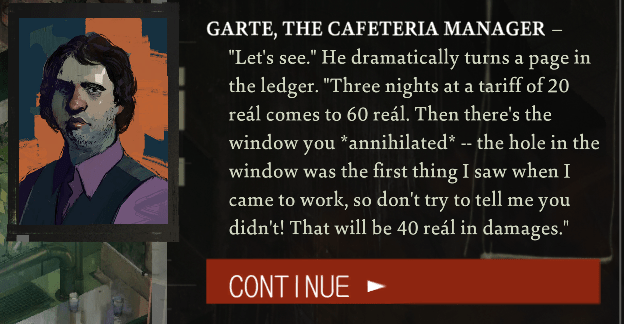
Yeah…. not exactly the type of person I’d want to be, as a man with college debt I don’t need any more. Thankfully because you’re a cop you can whittle it down to only 30 real if you pass a check (more on that later). But one specific character comes to mind that is pivotal to the game: Lieutenant Kim Kitsuragi
This man is the Pancho to your Cisco (I’m dating myself by making that reference AND also not helping the comparison as they were outlaws), the straight man to your absurd and unorthodox methods. Seriously, he’s a great character and is along for the ride every step of the way. With him in tow, we go behind the Whirling-in-rags to investigate the body, where we come across one of my least favorite characters in the game, Cuno
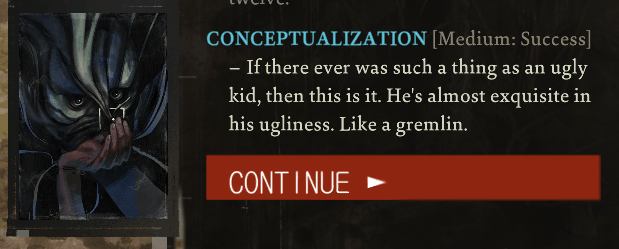
Unlike my fellow contributor to the Cosmia blog, I’m an individual who doesn’t usually swear and finds the act of using such vulgar language in common speech rather childish. Part of my heritage is Italian, and over in Italy the common swears you would use are considered childish, and shows a lack of maturity. So encountering such a deplorable little snot like this in games definitely grinds my gears to no end. He’s currently using the dead body we’re here to remove as target practice, chucking an infinite amount of stones at the corpse for all eternity if you’d let him, but thankfully stops when you approach the corpse and squats down on the snow-covered ground. Talking with him and his accomplice Cunoesse (unrelated) yields the overall attitude towards authority in Revachol: You’re not wanted and deemed as as problematic nuisance at best, and a insignificant pest that needs to learn his place if you overstep your boundaries. Some are indifferent, others take advantage of you, and the rest treat you just like Cuno does.
It is worth noting that you’re given a variety of things to say towards people that you meet, and may/may not receive insight on what happened the night of the murder. In the case of Cuno, he could care less about the body but can be persuaded to help remove it if you convince him that it’s invading his space. But back to the body, you and lieutenant Kitsuragi approach the body and inspect it visually before getting it down, in which you’re introduced to one of D.E’s main mechanics: the roll system. The game takes a bit of an inspiration from Dungeons and Dragons by having you roll a die for a result for an action that you may/may not fail. Increasing your specific traits or wearing certain clothing may give you points to increase the percentage to have a higher chance of success, and you can even get it up to 100% chance of happening in some instances, but for the early game said dice rolls are very low and highly unlikely. In this case, inspecting the body has a 17% chance of success, which you’ll undoubtedly fail unless you’ve got a rabbits foot and horseshoe handy (note: doesn’t always work) in this case, I fail and throw up a few feet from the tree.
Both the horrid gremlin children mock you for blowing chunks, but Kim’s got your back and gives you a monogramed handkerchief and reassuring words that hardly anyone gets used to the smell (he’s gone nose blind to it though, but certain stenches do knock him off guard a few times). So you’re told to get some gloves and ammonia to help make the process a bit easier. This is easily done by talking to a nearby gardener and she’ll just give you the gloves and ammonia, but even then it’ll take a bit to be able to approach the body. If you drag your heels in getting the body down (like I did the first time I played D.E) Kim will pull you aside and tell you that while it is tough being a detective, you’ll have to get your metaphorical $#!% together, which becomes a potential thought for you to internalize. I could give a whole play by play, but there’s a LOT to this story with numerous subplots intersecting the main one, I will be discussing the ending though, so be warned.
The Gameplay
Disco Elysium has an interesting top down perspective where you control Detective Dubois by clicking on an area with the mouse similar to most point and click games like King’s Quest. As mentioned before, the game has a sort of D&D dice rolling mechanic where certain checks are placed in dialogues with characters. You’re given a percentage based on how much point investment you have in the stat it requires, which can be increased by leveling up that specific stat or wearing certain articles of clothing to provide boosts to that stat when worn. Said checks come in red (one time only, you fail it and it’s gone for good) or white (if you fail it, level up to get another chance). You’re not limited to levels and clothing to increase your chances of success, however. There are a few times where your exploration of the dialogue choices will provide you with bonus multipliers to make passing them easier.
More often that not, you’ll be exploring the ruined city for bottles and other items of note to pawn off to either the drug store or pawn shop. You can highlight them by holding down Tab and clicking on them to either pick them up or interact with them. Honestly, there’s not much to really say about the gameplay compared to A Plague Tale (this game’s counterpart for the trade).
The Cast
In a mystery solving game like this or Danganronpa (a title I’ve had to play through on numerous occasions for this little trade, often to my misfortune) you’re guaranteed a cast of colorful characters. From Plaisance the bookstore owner who implores you with “magic” (translation: new age hogwash) to the insidious union leader Evrart Claire you’re always treated to an interesting conversation whenever you meet someone new. The interactions you have with the denizens of this bombed out husk of a seaside town are very unique, and you’ll likely get a gist of the general vibe of whoever you’re speaking to within moments of your first interaction. Though Revachol gives off greenland/poland vibes in terms of setting, the inhabitants have a variety of accents to them that are definitely not from Europe. Evrart for example, speaks with what I can only describe is a Bostonian snake oil salesman’s voice, while Titus Hardie speaks with an American accent. That isn’t to say that these people couldn’t have merely moved to Revachol, but Evrart is explicitly stated to have gone to the same school as Easy Leo (another character with a british (?) accent). Throughout the game it’s made abundant that Revachol isn’t an ideal place you’d want to move to, and most of the locals have it pretty bad with little in terms of employment or material goods, but don’t have many other options but to stay in the crumbling “tourist destination”.
That being said, I do have a few favorite characters like Evrart Claire, if only for the outlandish things that he says sometimes. With Mr. Cosmia, I often make preposterous claims and ask why they haven’t been initiated by those around me (such as forming an entire town near a central town that already has neighboring towns north, east and west of it. Nevermind the fact that said town south of the central one would be in the Atlantic ocean, it needs to be done!). And while I don’t condone Evrart’s actions throughout the game (he has Harry open a door to a local “weasel’s” apartment to intimidate him, and plan to forcibly evict an elderly woman and a single mother of 3 from their homes to build a community center that won’t ever be finished) I can at least appreciate some of the good lines he provides, like this one regarding a man so rich that he bends the light around him, and stows away in cargo containers to save money.

Another notable favorite is Leonard Bellec, better known by his nickname as “Easy Leo”. He’s a loveable old man who’s just eager to please Evrart Claire and really anyone he comes across. By the time you actually meet him most if not all of the interactions you’ve had with the characters range from brusque yet justified with a slight hint of contempt (Garte) at best, to outright disgust and malice (Cuno) so it’s nice to encounter someone with genuine politeness in an otherwise cold town. He’s also got a wife but no children unfortunately, and that makes me a bit sad. Infertility is an issue that I don’t think a lot of games tackle these days, and even if they do it’s often brushed aside as superfluous fact of a character.

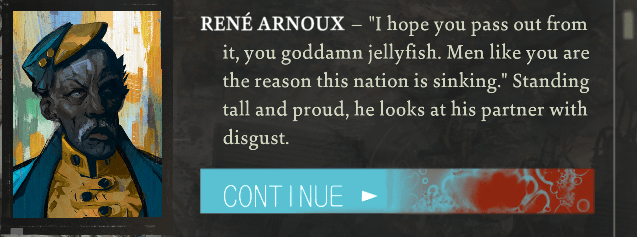
Rene Arnoux is another character that I can respect. As an old war veteran he voices his disgust towards those who let revachol fall to ruin, and wears his army uniform constantly, arguing with his neighbor about the state of the world and will rope anyone into the conversation just to vent his aggression towards. He also gets in a good line, though I’ve gotta deduct points for him calling a sea jelly a “jellyfish”. Get with the times grandpa, since 2007 they’ve been classified as jellies as they don’t have any bones!
And of course, there’s the choice in best girl, and for me there’s no question on who it is: Lilienne Carter

This is a woman who’s had it rough in life, she married a drunk sailor whose penchant for alcohol got him killed at sea, is effectively trapped in Revachol in a ramshackle house and is left with three kids to raise by herself. But in spite of all of that, she’s bound and determined to care for her kids, routinely going out on her fishing boat to provide for them. Due to the unsavory folk in Martanaise, she has to defend herself/intimidate them, but how does she do that? not with a gun or a knife, but with a freaking SABER! She’s also got this great pirate vibe going for her with the boat and sword, and as I’ve learned from media, pirates are cool when they’re not forcing their will on people and enacting violent drunken scuffles. You can even have Harry go on a date with her, and she’s appreciative enough to gift you her saber, what a lass! (Also, there’s not a whole lot of other options, most of the girls in the game are children and that’s a line I’ll never cross, Plaisance is annoying, and the less I say about Klaasje the liar the better.
The End Game (obvious spoilers)
After a while of goading and prying from the populace, you figure out that there’s only one place left for the culprit to hide: the abandoned factory in the northwest. In keeping with the game’s open ended solutions there are two entrances you could take: Climbing a rusty and unstable ladder to the roof, or inspect an area beneath the boardwalk for a door leading into it. And with that, you enter the passage and crawl through the abandoned tunnels, until you finally have the climactic showdown with the hero hanging hooligan, pawn of the infamous crime boss La Puta Madre and lover of woman, Ruby the Instigator.
However, unlike most conflicts that begin with a standoff, Ruby catches you off guard and uses a pale latitude compressor, a machine that put simply, sends out a loud frequency within a short radius that’s loud and confusing enough to disorient you and lieutenant Kim, and if I were present, would probably kill me in 3 seconds on account of my overly sensitive hearing. After some time, you can talk with Ruby to learn more about what really happened that night. As it turns out, Ruby was planning to leave Revachol with Klaasje due to both of them being on the run (a real Thelma and Louise situation), but those plans couldn’t come to fruition when her lover (the mercenary strung up in the Whirling-in-Rags courtyard) was killed. Instead of going to the police or at the very least cutting and running, Klaasje for whatever reason decides to make this situation even harder and more complex than it already is by convincing Ruby and the Hardie boys to make his death look like a lynching. And as Ruby reveals, this wasn’t HER plan, Klaasje wanted this, and effectively pinned the blame for it all on Ruby. With enough of the conversation heard and Ruby distracted, Harry Du Bois can stumble over to the compressor and destroy it, freeing himself and Kim from it’s oppressive waves.
Outnumbered and cornered under the boardwalk with nowhere else to go, Ruby decides to go the cowards way out and place her gun in her mouth. And this is where I think the game could’ve given more options for this situation, because there’s only two
- 1: Fed up, Harry can tell Ruby to just go, and that they won’t hunt her down, Ruby runs off stage right and Kim says that was the right thing to do, because even though she got away, her life won’t be easy on the run.
- 2: Harry tells her that she’s under arrest and to put the gun down, to which Ruby pulls the trigger, ending her life and leaving quite the mess for the detectives to clean up.
There is no third option to capture her like Klaasje, and I hate that. One main thing with me is that I hate liars, and I especially hate when said liars have to make others lives harder. What I WANTED to do was send Klaasje to the slammer (actually doable, despite her protests and offers to routinely check in with the RCM, but why the hell should I trust this habitual liar?) and eventually send Ruby there, getting both of them off the streets of Revachol (Ruby’s no saint, she’s a part of a notorious drug cartel and has no doubt done a lot of bad things that are much worse than covering up a murder) and hope that Ruby makes Klaasje her prison (censored) as punishment for betraying her but nope, she either flees or dies by suicide. Either way, there’s not much left to do but return to the whirling in rags, where you encounter a true Mexican standoff between the seven hardie boys and three mercenaries.
Now this is the turning point in the story, as most of the hardie boys can survive the firefight, or none at all. The mercenaries are angry that their commander was killed, and want retribution believing the Hardie Boys were responsible, and the Hardie boys stand in their way, with Lizzie trying her damndest to mediate this tense situation. Harry Du Bois and Lieutenant Kitsuragi rush in to the center of the conflict, the only neutral party that wishes to lessen the bloodshed that’s already been spilt. This requires passing a lot of difficult speech checks (some of which you can make easier by distracting the mercenary commander) to try and diffuse the situation, but no matter what you do, no matter how good your intentions are, a firefight will break out, and you’re inevitably going to take a bullet. Thankfully my diligence in trying to go after what side quests I had gave me some of the dead merc’s armor (more importantly, the cuirass, which will always stop one bullet) so I was fine, the Hardie boys however, lost quite a few members in my first playthrough. Only 2 of the seven Hardie boys survived, the rest perished in the scuffle, including Titus himself. When Harry regains consciousness though, there are two possible outcomes:
1: If Kim trusts you, you’ll be able to pass a check that allows you to tell him to watch out at an integral part of the fight, which he’ll do, saving his life and keeping him as your partner for the rest of the game.
2: If Kim doesn’t trust you or you fail the check, he’ll be shot and evacuated out of Revachol gravely wounded (but not dead). And in place of Lieutenant Kitsuragi, the man who beats me at strategy games without lifting a finger (like someone else I know) and pulls off a good pilot’s uniform, you get Cuno as your partner for the remainder of the game.
…..What?
Yeah, that’s gotta be the bad ending right? being stuck with the detestable little snot gremlin for the remainder of the game, him following your every move for the remainder of the case and swearing like a sailor. Honestly, if I die and go to hell it’ll be listening to this red-haired imp rattling on about himself in the third person for all eternity. But nonetheless you start to realize that the case remains unsolved. Klaasje’s either in prison (or ALWAYS in prison for lying to an officer, in my playthroughs) or forced to routinely check in with the RCM, Ruby’s either on the lam or dead and the Hardie boys, despite confessing to the crime (a false statement) and helping assist Klaasje in covering it up (their actual crime, which would make them accomplices) are either mostly dead or suffered minimal casualties. You’ve explored every bit of Revachol, and no one is standing out as the true culprit, that is except for the fort. You and your partner decide to investigate the crumbling sea fortress after borrowing the pirate woman’s boat, and venture to meet the true culprit of the murder: A man known to many as The Deserter.
Throughout the game we are told of the revolution that left Revachol in the sorry state that Harry and Kim explore in the modern day. It’s almost eerie seeing people living amongst the many damaged buildings and using mortar craters for ball games, treating it like any other city. As it would turn out, there is a sea fortress located in the middle of the bay that surrounds Revachol, only reachable by boat. And amidst the stone ruin sits a singular remnant of the revolution, a man who kept fighting well after the war ended and never wavered from his ideals: Iosef Lilianovich Dros
Upon discovering him, he raises his sniper rifle, only to remember that it’s out of bullets. From there you get to the meat of the discussion: why he did it, and how. As it would turn out, he was a political commissar of emergency defence at the sea fortress, and looked as an exemplary individual to his subordinates. When the enemy of the communists (oh yeah, he’s a communist, forgot to mention that) landed on nearby beachheads and began to massacre his fellow soldiers, he fled to the mainland and hid in a bunker until morning. Following the dawn of the next day, he swam back to find no survivors, all of his soldiers dead from bullets or drowned in the sea as the anti-aircraft gun malfunctioned at the worst possible time. Filled with rage, he continued fighting a battle that he had no chance of winning on his own, and slowly turned into a vagabond that periodically returned to the mainland for supplies. From his perch he watched the citizens of Revachol, and gradually grew attached to Klaasje. When she began sleeping with the mercenary (the man who was hung from the tree) he decided to kill both of them out of rage. He succeeded in killing the merc, but couldn’t bring himself to shoot Klaasje (good thing I put her away in the slammer), which eventually left a paper trail for Kim and Harry to follow.
There’s something about soldiers that continue fighting despite their hopeless situations that really makes me think. Iosef’s story reminds me of Hiro Onoda, a Japanese officer in World War II who continued fighting until 1974 out of loyalty to his country and following the orders given to him to the letter. Despite Japan surrendering in 1945, he and a few of his comrades continued to fight on Lubang Island in the Philippines, refusing to surrender unless told by their commanding officer directly. Any attempt to tell them the war ended was interpreted by the group as a trick by the enemy, and the innocent locals were often seen as the enemy in disguise. Eventually, his commanding officer was tracked down by a tourist, who went to Lubang Island to personally relieve him of his duty, and he finally surrendered to the authorities before being given a pardon. Given my habit of calling some folks soldiers (because in my eyes, we’re all soldiers fighting our own battles, sometimes they align with others and other times they don’t) and general demeanor I guess I’ve just developed a fascination with the concept to a degree. But while I don’t intend to serve in the military, I do respect them for their sacrifice and willingness to fight to protect what they hold dear. That being said, the blind loyalty displayed by Iosef and Onoda makes me wonder if such loyalty is a good thing. If the soldier is that dedicated to their militia that they would consider any attempt of persuasion to surrender a trick of the enemy, then what’s really stopping them? If Onoda’s commanding officer died in the war (or of anything really) before relieving him of his duty, he’d likely still be up in the mountains killing civilians that he thinks are the enemy until either he dies from retaliatory fire from the locals or of old age. As much as I respect the military, I think there’s a fine line to the loyalty aspect, and I’d at least seek out second and third opinions before writing off surrender attempts.
What was that? the review? oops, got a bit sidetracked there. I won’t spoil the rest of the game, but it wraps up rather nicely, with a few of your decisions being brought up by Kim to other officers (In my first playthrough, I asked people for money a lot, and he mentioned to them how unprofessional that was, but in my defense I was broke and collecting bottles to pay rent).
The Rodent Quota
As touched upon by Mr. Cosmia himself, the rodent quota is something that the game trade has always acknowledged even during the great Persona 5 X Kingdom Hearts exchange (the first one, essentially). Both of those games featured rodents in some capacity (Persona 5 had the party temporarily turn into mice during a specific dungeon, and Kingdom Hearts is a joint creation by Square Enix and the Walt Disney company, the latter of which have a mouse prominently featured as their mascot) and there have been other examples in the past that I can’t think of. Does this game have any rodents to speak of?
No, aside from a offhand mention in a remark there are zero rodents to be found in Disco Elysium, and that is shocking. Given the ruined state of Revachol and the MYRIAD of abandoned places that Kim and Harry explore you don’t find a single rodent or evidence of murine intervention in any of them, despite them going hand in hand with ruined/abanadoned civilizations. So in terms of the rodent quota this game fails, sorry Mr. Cosmia, a mention of a rat does not count as representation.

The Verdict
Disco Elysium is a game about a washed up detective fighting for his precinct to see him as more than a failure, the question being is whether or not he can remain sober enough, and the myriad of issues that stand in his way. Given the foul language and frequent drug usage I can’t say it’s my cup of tea, but I imagine it is for someone else. That being said, the watercolor visuals and portraits for the characters was a very nice addition that they didn’t have to do, definitively breaks the gritty film-noir style that these games often get saddled with. Would I seek out this game for myself independent of the trade? probably not. Did I have a good time? yeah I guess so. As I said, the humor isn’t my cup of tea but I can respect the art style at least. The game gets a 7.5 out of 10, it would be higher if it was my type of game and Cuno didn’t exist, but what’re you going to do?
Tune in next time for more sophisticated discussions, some made by Mr. Cosmia, or me!
 Cosmia
One response to “Disco Elysium: The Final Cut Game Trade Review”
[…] area, Elysium. Unfortunately there’s no disco in this one but if you want some you can read a certain Spartan’s review of that here. This area seems a lot more pleasant and peaceful at face value. It’s green! And ethereal! […]
LikeLike