Hoi folks! Spartan here with yet another review for the time honored Game Trade, where Mr. Cosmia gives me something to play/review and vice versa. Let’s see what we’ve got today, really hoping it isn’t a FromSoft game…….
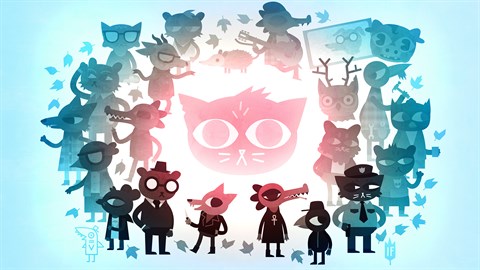
Oh, Night in the Woods, perfect! I live to see another day without having to put up with Dark Souls level difficulty of combat. I remember reading about this in a GameInformer magazine once and how it tackles a college dropout returning to a small town where not much goes on. I didn’t drop out of college but I live in a small town so this will be a refreshing perspective to me.
The Story
Our story begins with our protagonist returning to the rundown town of Possum Springs via the bus station. She’s about to leave when the handyman duck (handyduck?) gets in the way of the door
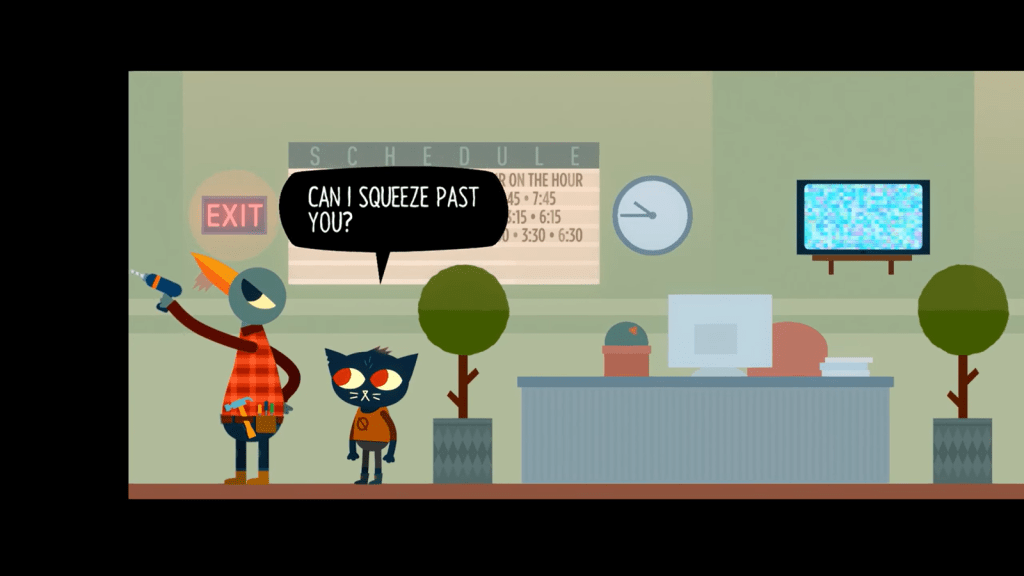
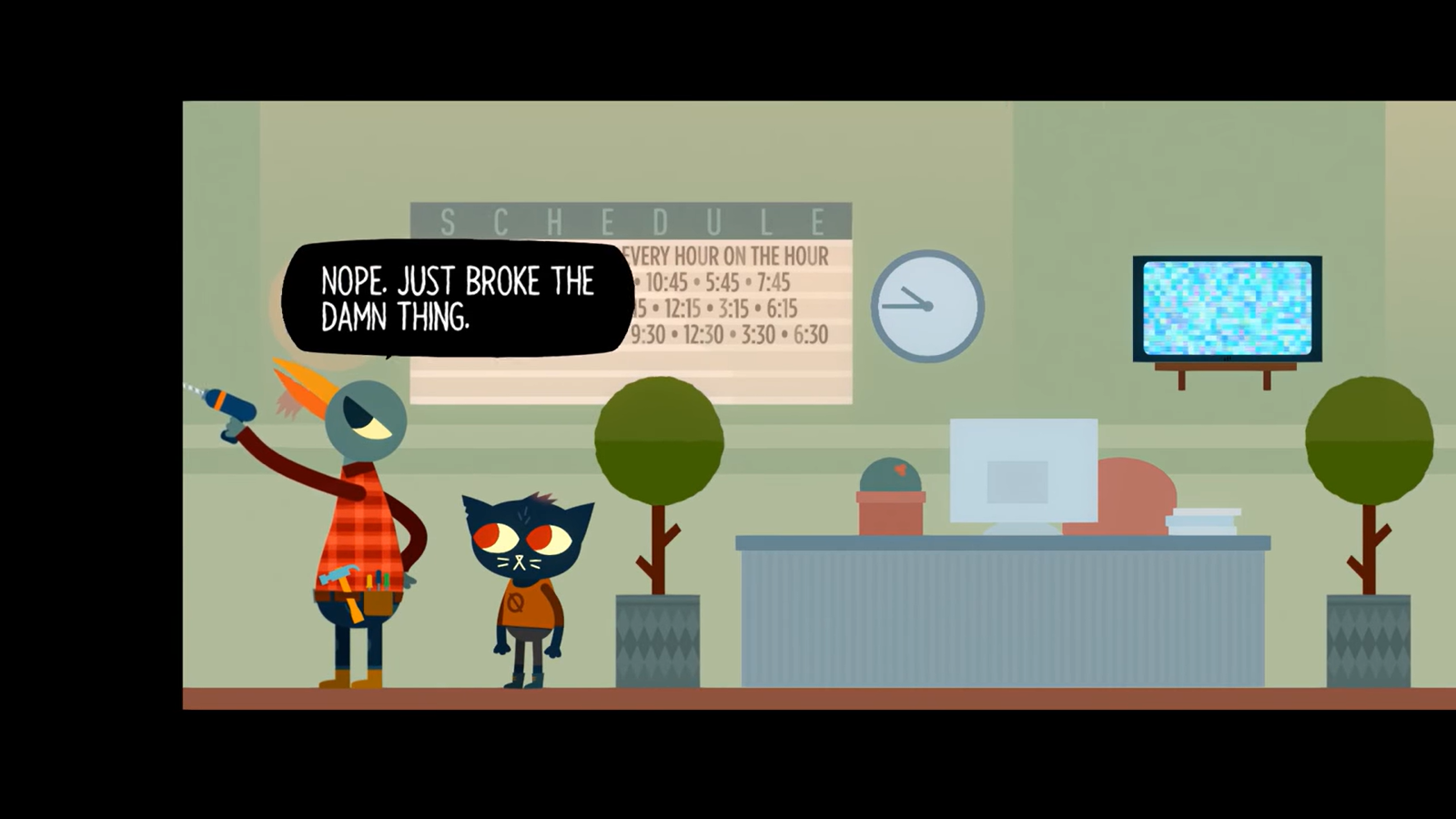
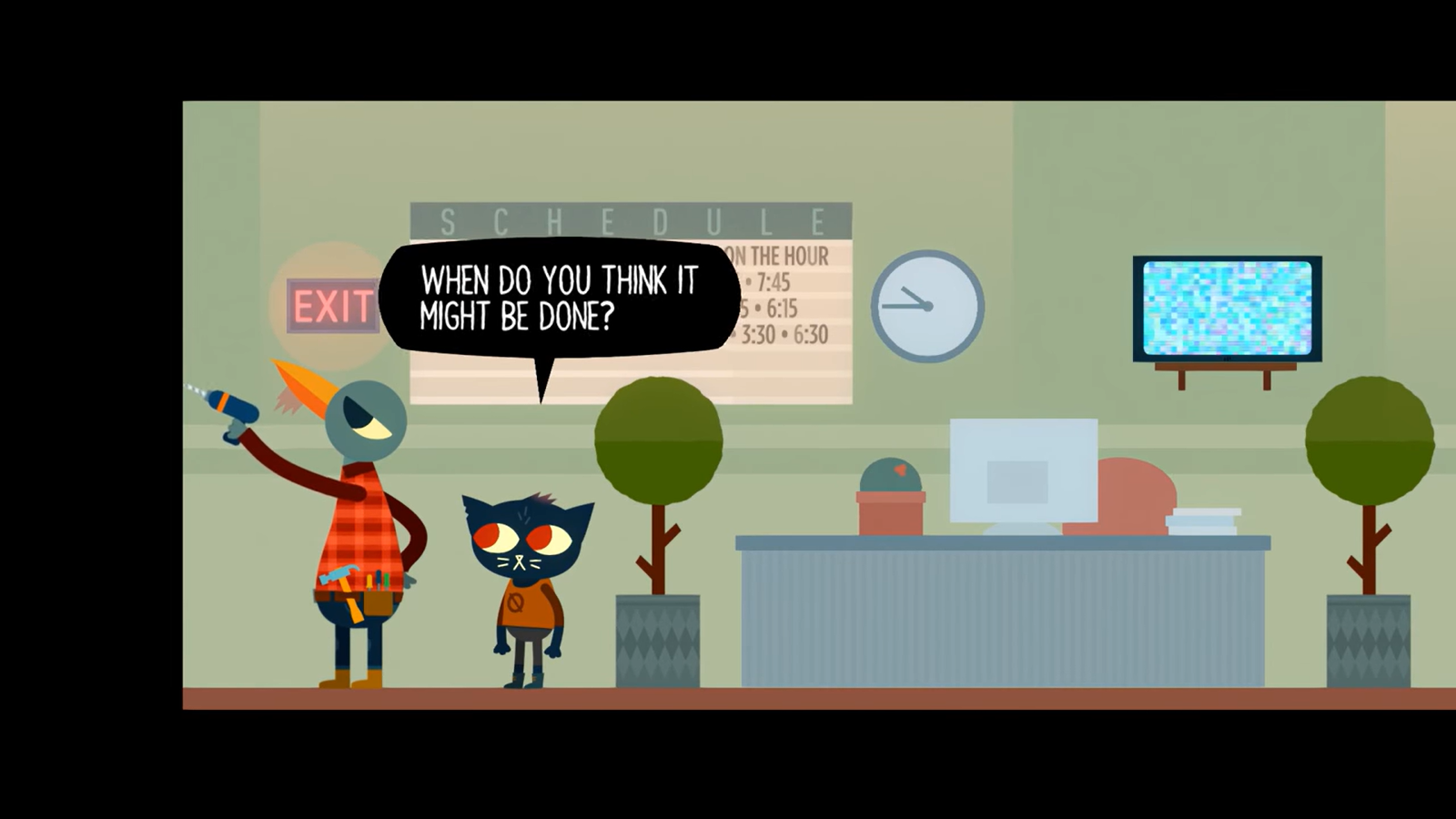
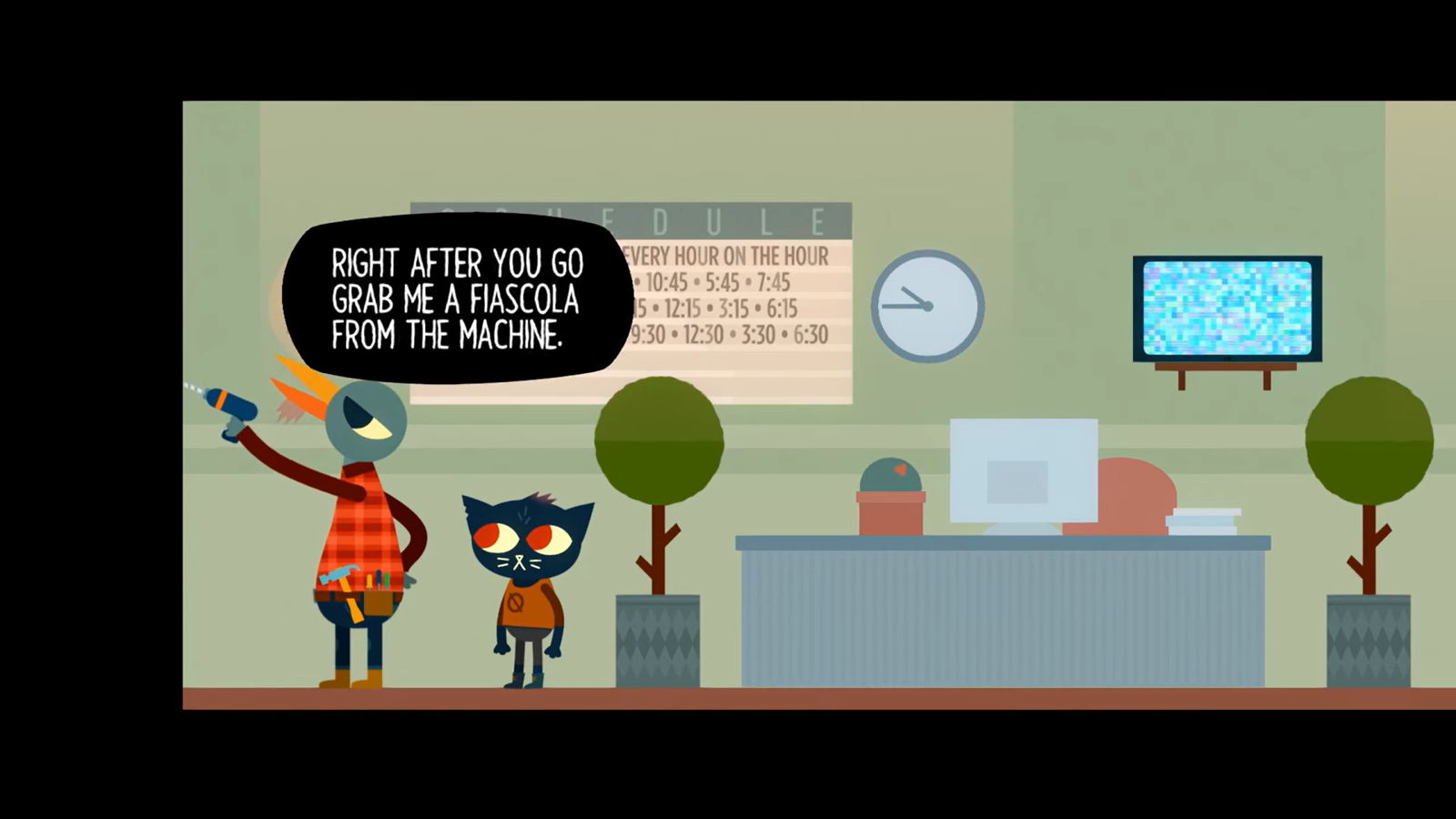
So naturally, you’ve got to retrieve something across the room that he can’t get by himself, which is a classic RPG trope that needs no introductions. I’m just surprised he doesn’t ask us to eliminate the vermin in the bus station, though I imagine that would be slightly racist in this society.
After getting the man his Fiascola (love that name) he moves aside to let you out of the bus station. And from their you cross through the woods… at night! Eventually you’re caught by a cop (who happens to be your aunt) and she escorts you to your house, where your parents are instantly apologetic over forgetting to pick you up. But Mae is cool with it, and even pretends with them that they did just that.
The next day, Mae wakes up in her bedroom that hasn’t changed since she last saw it. For people who go to live on campus, I imagine it’s a strange feeling returning to your old room after a semester (or college entirely). The clothes that sit in your closet might fit, but you’re not the same person who last put them on. Everything would be exactly as you left it, frozen in time the moment you went away, like Pripyat after the Chernobyl incident. Heading downstairs Mae meets with her mother in the kitchen, and asks about Gregg (one of her friends). Your mother mentions that he now works at the Snack Falcon, so off you go to reunite with an old buddy.
The Setting
I would be remiss if I didn’t analyze the setting, because it’s one of the more out there as far as I can see. It seems to take a few pages from the Goofy and Pluto dilemma, where some characters can walk, talk and drive cars, and others are just the animal they are (a bird flies, eats seeds and lives in trees) with no capacity for a higher intellect beyond what their species normal mental facility is

Night in the Woods seems to take this setting in stride though as they don’t seem to see their nonhuman denizens as actual people. A bird is kept as a pet in the Borowski household and acts just like one, while the Borowskis are able to routinely meet and converse with bird people like ducks and crows, and maybe even invite them to their house. If the bird person sees the pet bird, do they question it? do they see it as slavery? or is it just a matter of “oh, what a lovely bird, it sings so sweetly” and nothing more?
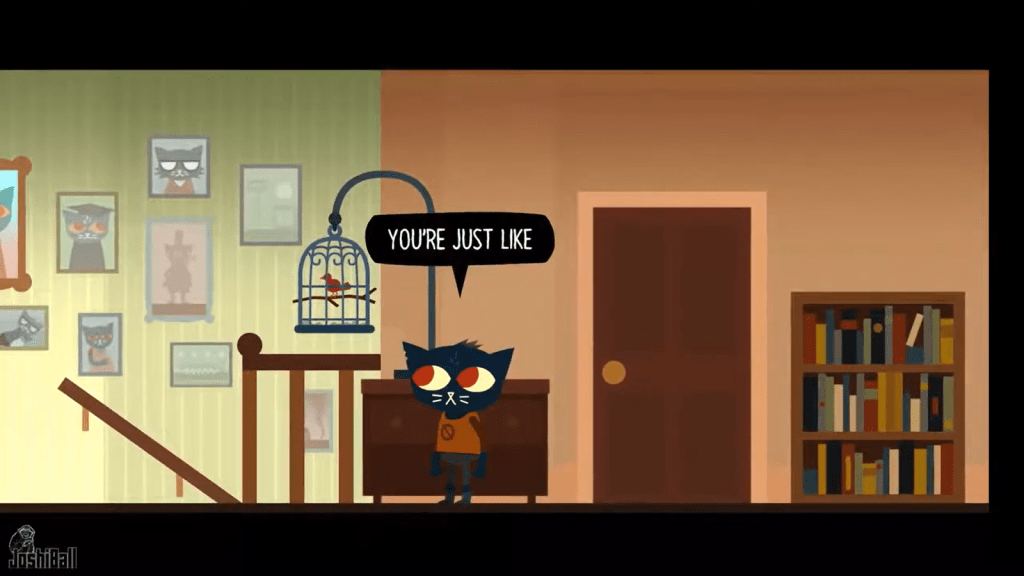
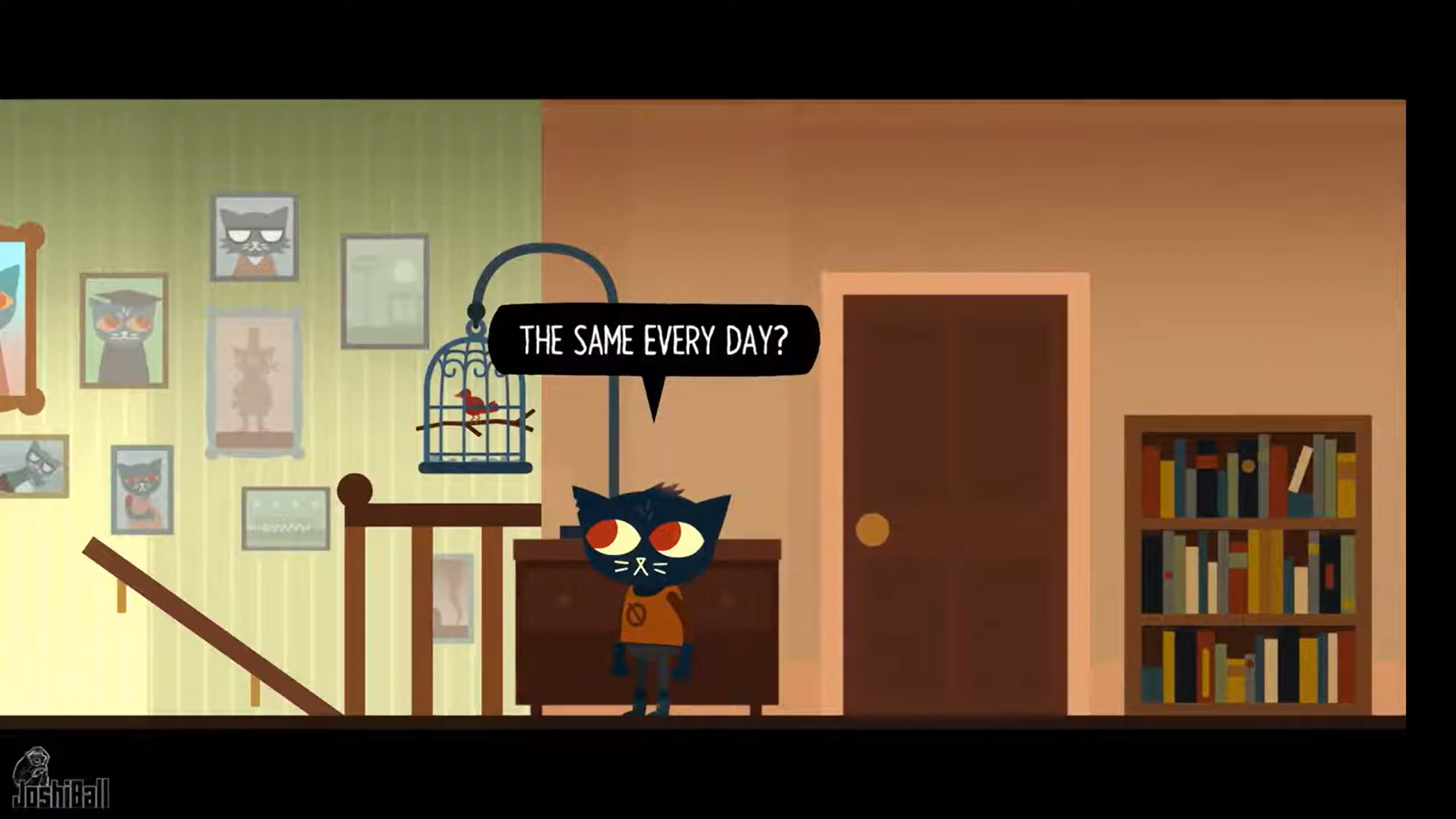
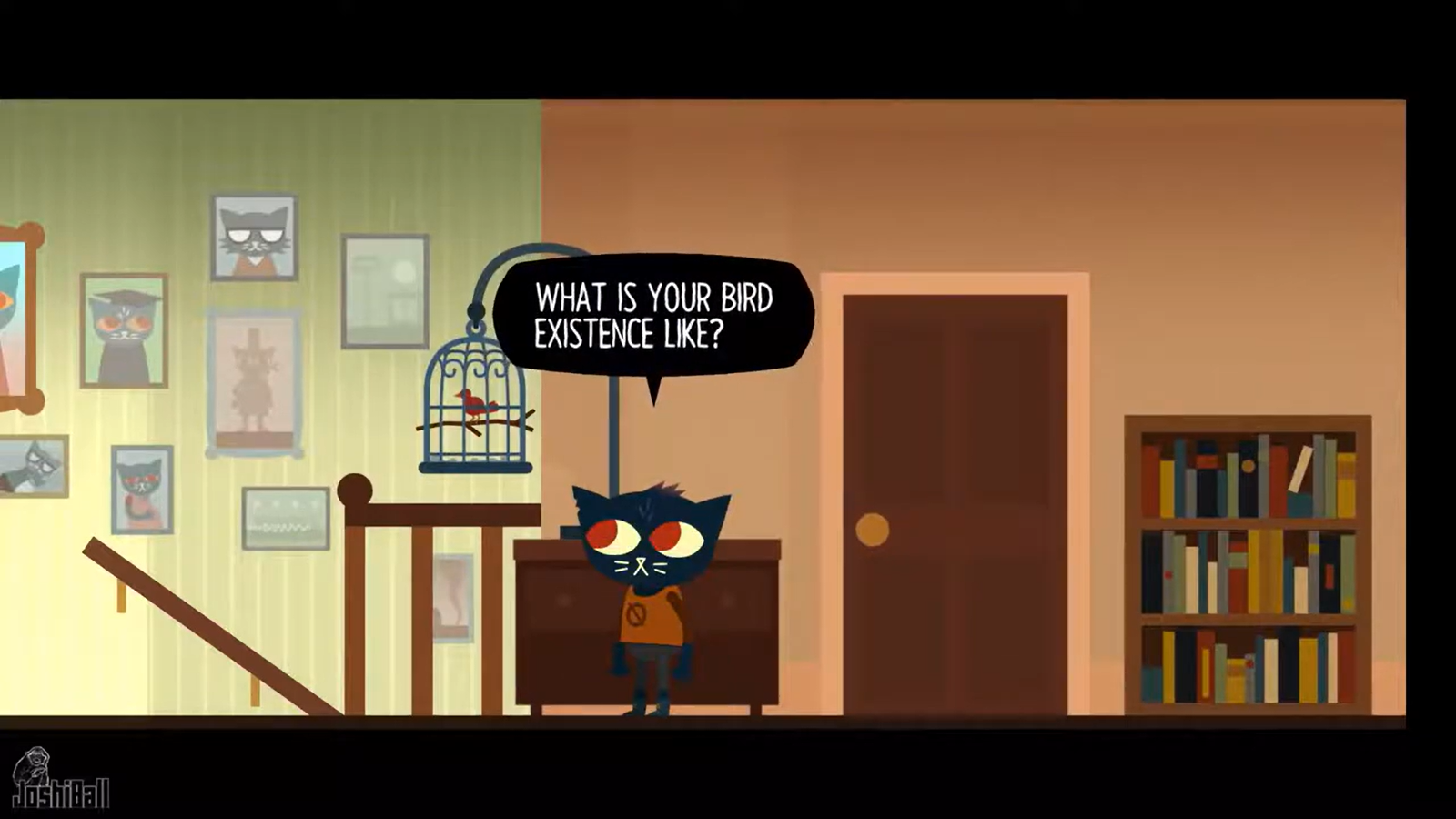
Rats and possums are plentiful in Possum Springs, and act exactly as their real life counterparts, scrounging up food and making nests. Yet during Bea’s route, Mae and Bea go to an elderly possum (or rat? I’m not sure) house to fix her boiler. If she has a rat infestation in her house, is she able to kill them? does she have to hire someone to exterminate them? or because they’re the same species and share a kinship, is she prevented from doing so in that society, as it’d be considered killing one’s own race,
And that’s another thing: Race. NITW seems to employ animal species as a replacement for different ethnicities. It’s not a 1:1 similarity, but there are some traits that can be derived from certain species. But by doing that AND having regular animals in the world complicates things. If the Borowski’s were to kill their pet bird, would that be seen as a hate crime against birdfolk? or would that be okay because in nature, cats often hunt birds for sport and prey. Or assume a wild fox finds its way into the Borowski house and makes a den there. Do the Borowski’s have to put up with the vexing vulpine for the rest of their lives or can they kill it? Would Mae be able to look Gregg in the eye afterwards? would he be cool with it?
In the end, a lot of this doesn’t matter but as a biologist IRL I’d be remiss if I didn’t mention this stuff. Call it a curse or a blessing, but when it comes to nature being depicted in video games I can’t help but throw my two cents in. NITW though seems to take the anthropomorphism as merely a fact of life in their world. Normal birds can fly, but human birds can’t and reptiles like Bea can exist in cold climates despite being a poikilotherm where she otherwise would be put in a deep sleep. Though that does beg the question, do possum people possess colder blood like their feral relatives and are they immune to rabies?
Then there’s the ultimate question in how do they reproduce? Cats, possums and foxes are all mammals, and I would imagine be able to interbreed in this world, but what about the birds and crocodiles? Say I’m a crocodile in this universe, does that mean if I want to have kids of my own, my spouse also has to be a crocodile? Is Angus and Gregg’s relationship a tongue in cheek way of acknowledging same sex couples inability to reproduce? the world may never know.
Ultimately, it might be a matter of choice by the creator to depict differences between the characters without relying on race. After all, none of the characters directly mention their physical attributes nor acknowledge their similar appearance to the naturally occurring fauna of Possum Springs.
The Characters:
Anthropomorphizing animals has been implemented into the collective zeitgeist for thousands of years. Aesop’s fables, for example take advantage of commonly understood perceptions of animals (a fox is sneaky and conniving, for example) to quickly establish what a character is all about in a matter of seconds than minutes. Night in the Woods though, takes some of these aspects and throws them out the window for giving characters a distinctive style, which isn’t a bad thing. As a biologist I can confidently say that crocodiles don’t pierce their lips or chain smoke nor are they known for having “emo” personalities, but in NITW’s universe it’s pretty common in small towns. Let’s start with the main character Mae Borowski
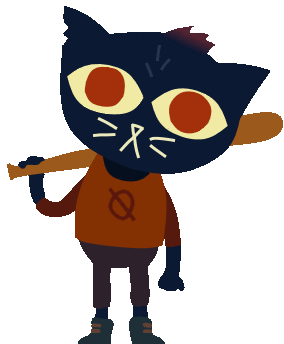
She’s a black cat that bad luck seems to follow, because she’s prone to plenty of misfortune. A college dropout who returns to her small hometown with no direction, she represents most young adults in their post primary years, that is one with no direction. Growing up we’re told that to make something of yourself, you need money, to make money you need a good job and to get a good job you need a degree. That’s what’s been instilled in us from adolescence and we’re often shielded from the painful reality that that doesn’t always happen. Some people don’t pursue a college degree for numerous reasons, some feel that they don’t have what it takes, others don’t have the funds to do so or are just burnt out from high school and want to just enter the workforce or the military to have them pay for college. And honestly, those are valid points.
Mr. Cosmia and I have graduated from college and received our diplomas (mine was a little late, but that was because of circumstances beyond my control, better late than never?) so we can’t really speak on the opposing side, but I’ve seen a lot of that side. Throughout my college career I watched as a lot of the people I signed up with in the same class wouldn’t be there at the end. Some elected to just stop showing up because the class didn’t interest them, or weren’t able to devote enough time on the material to score well and just dropped it. I remember being in a math class with set goals that you had to make on a weekly basis, and that class packed with at least 35 people in September dwindled to less than half by November because they just couldn’t keep up. And that’s the idea of college: at that stage of the game you’re an adult who has to make their own decisions. Professors won’t hold your hand and some might not even know your name by the end of the class unless you go out of your way to talk with them. But Mae’s reasoning for dropping out is deeper than that.
Most characters in NITW represent an archetype of the college age demographic, and in Mae’s case, she represents those with no goals. Her life has no direction, she tried the college life and that didn’t work out. Possum Springs was a mining town at one point and it’s slowly becoming a modern ghost town due to the lack of options it presents for its next generation. Throughout the game it’s made abundantly clear that the economy is dying with numerous businesses going bankrupt. So whatever prospective career Mae might find isn’t going to be around for long if things don’t change.
It’s also worth noting that Mae suffers from her situation, in that her parents can only do so much to help her. Her mother is a secretary at the local church and her father works at the local Ham Panther (a Costco-like grocery store) as a butcher, both blue collar positions with little in the way of promotions. Some children are born into families with numerous contacts that can get them a low ranking position in their companies, but not all of them. Yet both Mr. and Mrs. Borowski are able to make ends meet in a 2 story house in the suburbs. It’s not the most expansive house by any means, but it’s within a “safe” neighborhood and has served them well in their many years of living there.
Gregg
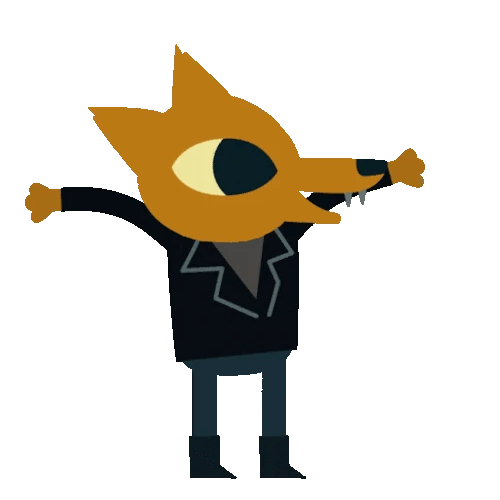
Gregg is one of Mae’s close friends, and someone who I most likely would hate in real life because he’s a troublemaker. He works at the Snack Falcon (an analogue to a 7/11 or any other convenience store) seven days a week to be able to save up enough dough so he and his boyfriend Angus can leave Possum Springs. Easily excited and quick on his feet, he’s estatic that Mae has returned home and makes numerous plans with her, even bringing their old band back together. But there’s a side to him that explains why he is what he is, as he describes himself as coming from “parking lot trash” that didn’t have much of a future until he met Angus. We don’t learn much about his home situation, but given his reluctance to talk about it already implies that it isn’t good.
Gregg represents what I call the “caged bird” archetype. He longs to be free from Possum Springs and move on to open skies but is trapped by the reality of his situation. Forced to work at a convenience store to pay for a crappy apartment that can’t even afford a proper alarm system (it shocks Mae, literally). He scrimps and saves every dollar in the hopes it’ll buy him the liberation he seeks, working seven day shifts to achieve that goal. Unlike Mae he has a direction in life, but that direction involves leaving the only home he’s ever known with the person he loves, with all the challenges of keeping that relationship that follows.
Through most of his route, Mae and Gregg engage in criminal acts such as theft of a Chuck E. Cheese knockoff animatronic and smashing up a car, while venting about their current issues. Their relationship is strengthened through rebellion and the two feed each others bad habits. Gregg is clearly elated that Mae is back in town and willing to indulge him in whatever his messed up mind comes up with.
Bea Santello
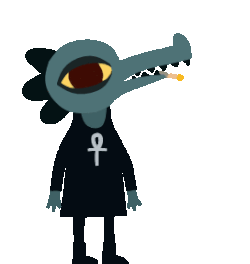
Out of Mae’s friend group, Bea is the one that is the most down to earth. Dressed in gothic attire with an ankh placed squarely below her throat, this chain smoking crocodile has aspirations to leave Possum Springs and go to college, but is prevented from doing so due to family responsibilities. She represents the “succession child” archetype, which is when a person is born into a family with a business and is then expected to continue that business regardless of whether or not they want to. There’s plenty of examples in media, like Yosuke Hanamura from Persona 4, Ember in Elemental, etc. And like most succession children, she’s not pleased with her fate. She envies Mae callously throwing away her college opportunity as though it were a mere gum wrapper, yet still keeps her around for “entertainment”. During my playthrough when faced with options on who to hang out with (either her or Gregg), I always chose Bea. Yes, Mr. Spartan elected to hang out with a chain smoking crocodile over an easily excited fox folks, call the presses.
As I went through her route, I saw what it’s like being a succession child. Her father runs a department store and she’s often sent out on house calls to fix issues. In one specific instance, Mae tags along with her to an old lady’s house, one known to lock repairmen in her basement. As Bea tells Mae to “just sit there” Mae constructs a noise machine out of various pieces of junk, and then eventually takes a bat to the furnace to get them out of there. While what Mae did indeed helped them, Bea reminded her that she did more harm than good, as they were supposed to FIX the furnace, not wreck it to pieces.
It’s made apparent that Bea is taking on a lot more than she can handle at the hardware store, or as she explains it
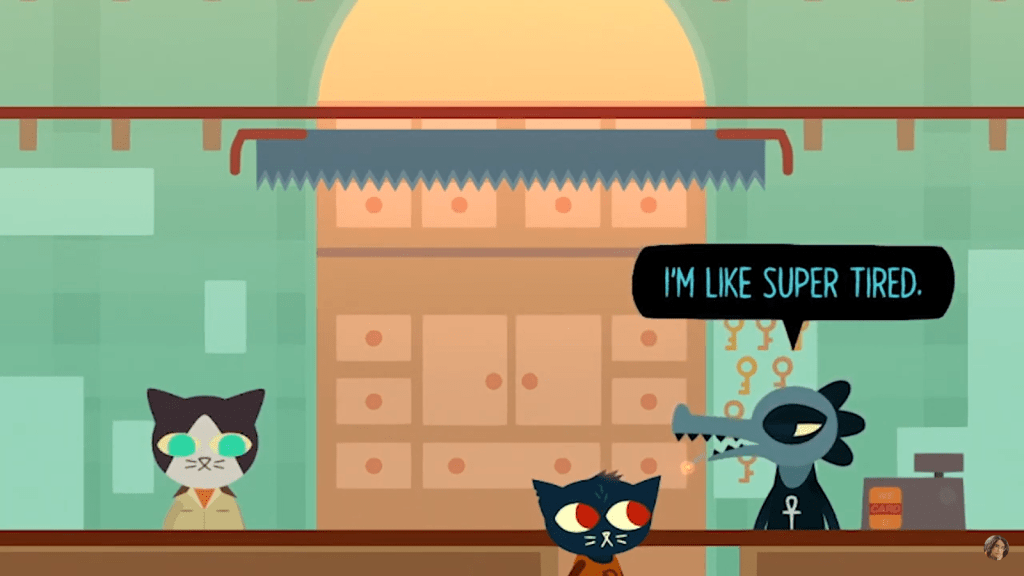
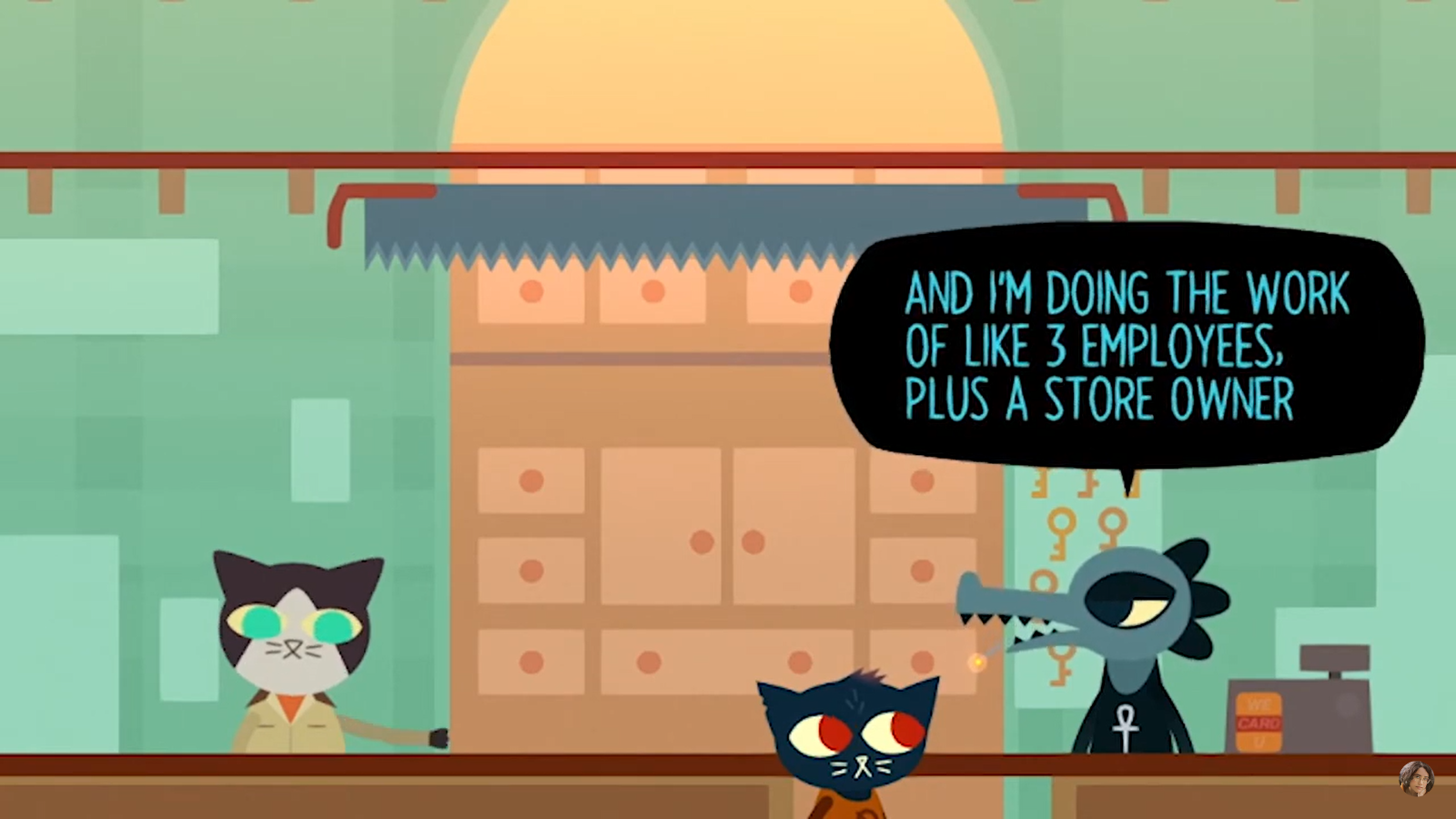
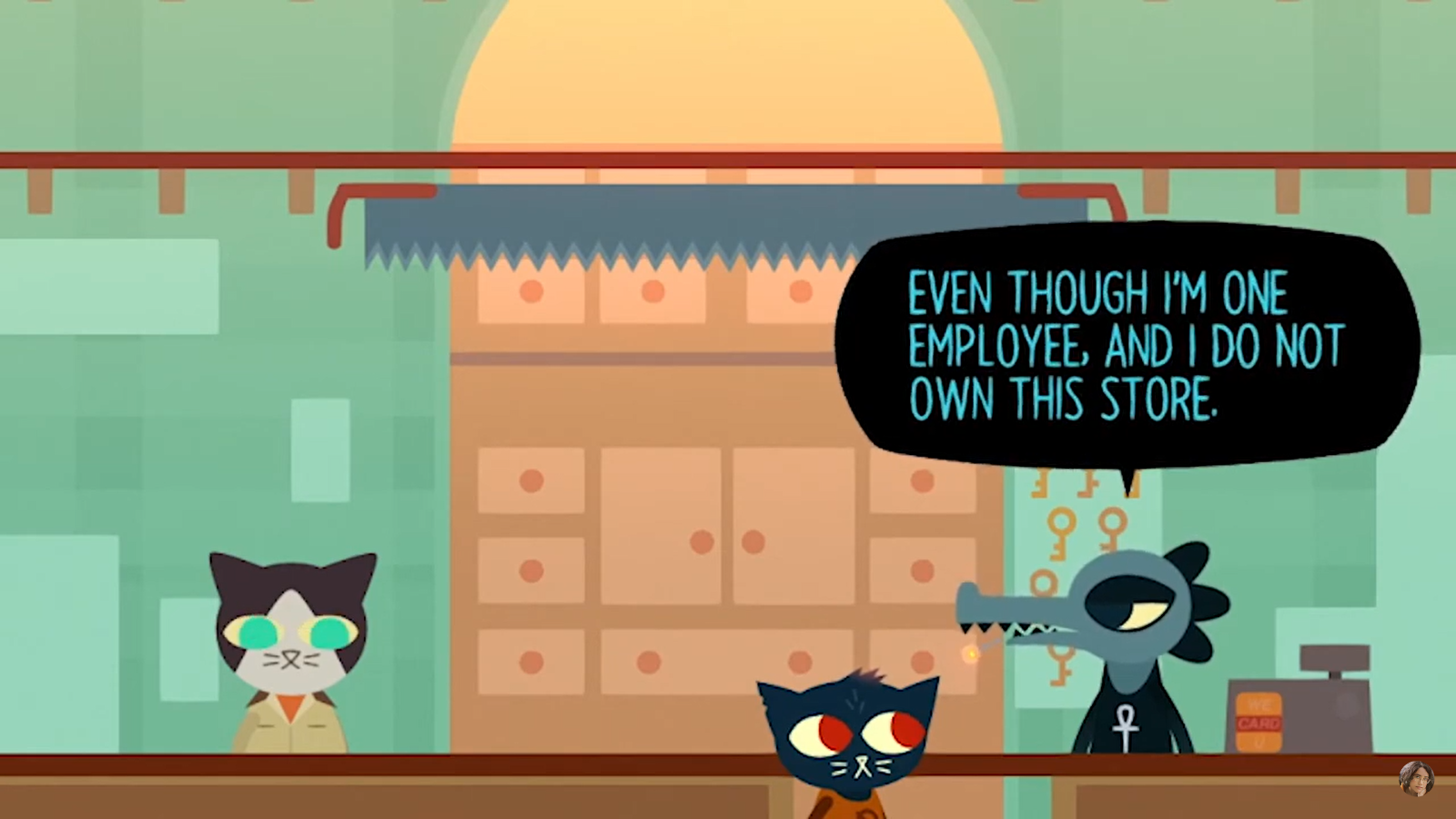
And that’s the unfortunate part of being a succession child, forced into a destiny that might not be to your liking and having to shoulder burdens well beyond normal employees due to their “birthright”. It’s a common issue in both NITW and the real world, and I only hope those succession children find something to enjoy in their lives, otherwise the banality will be very apparent.
It it worth noting that there are other characters like Angus and Mae’s parents that play roles in the game, but ultimately they’re along for the ride. Bea and Gregg are the ones you’re going to be spending most of your time with and you may/may not have other characters join them depending on their availability.
The Finale (Obvious spoilers)
Throughout the game there has been talk of Little Joe, the ghost of a miner from Possum Springs’ early years. No one knows how he died, but they know he is no longer living, and ghost stories have been perpetuating the town for decades after his untimely demise. It’s grown to such notoriety that even hoboes in neighboring cities refuse to get off of the train car in Possum Springs out of fear of him.
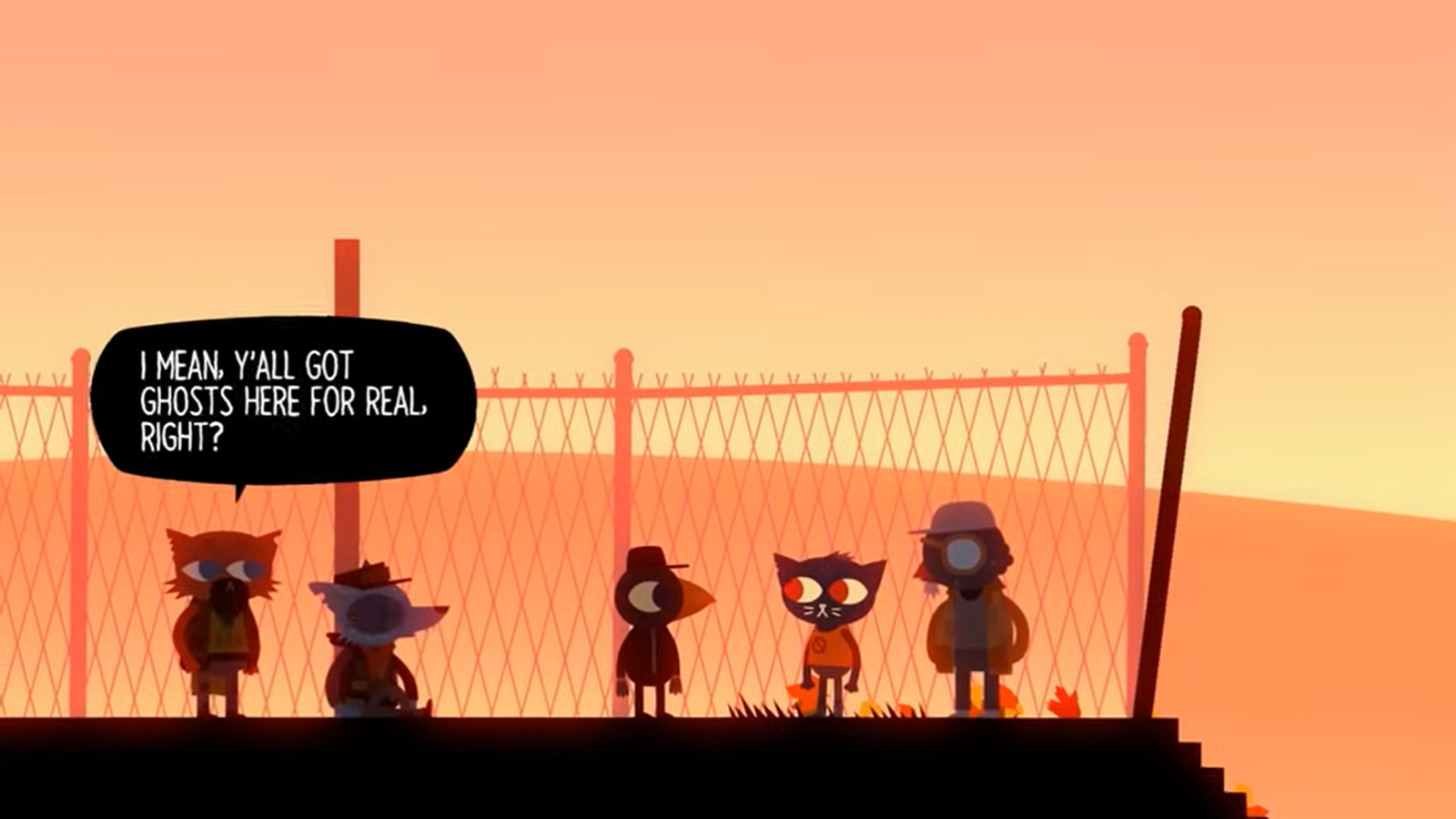
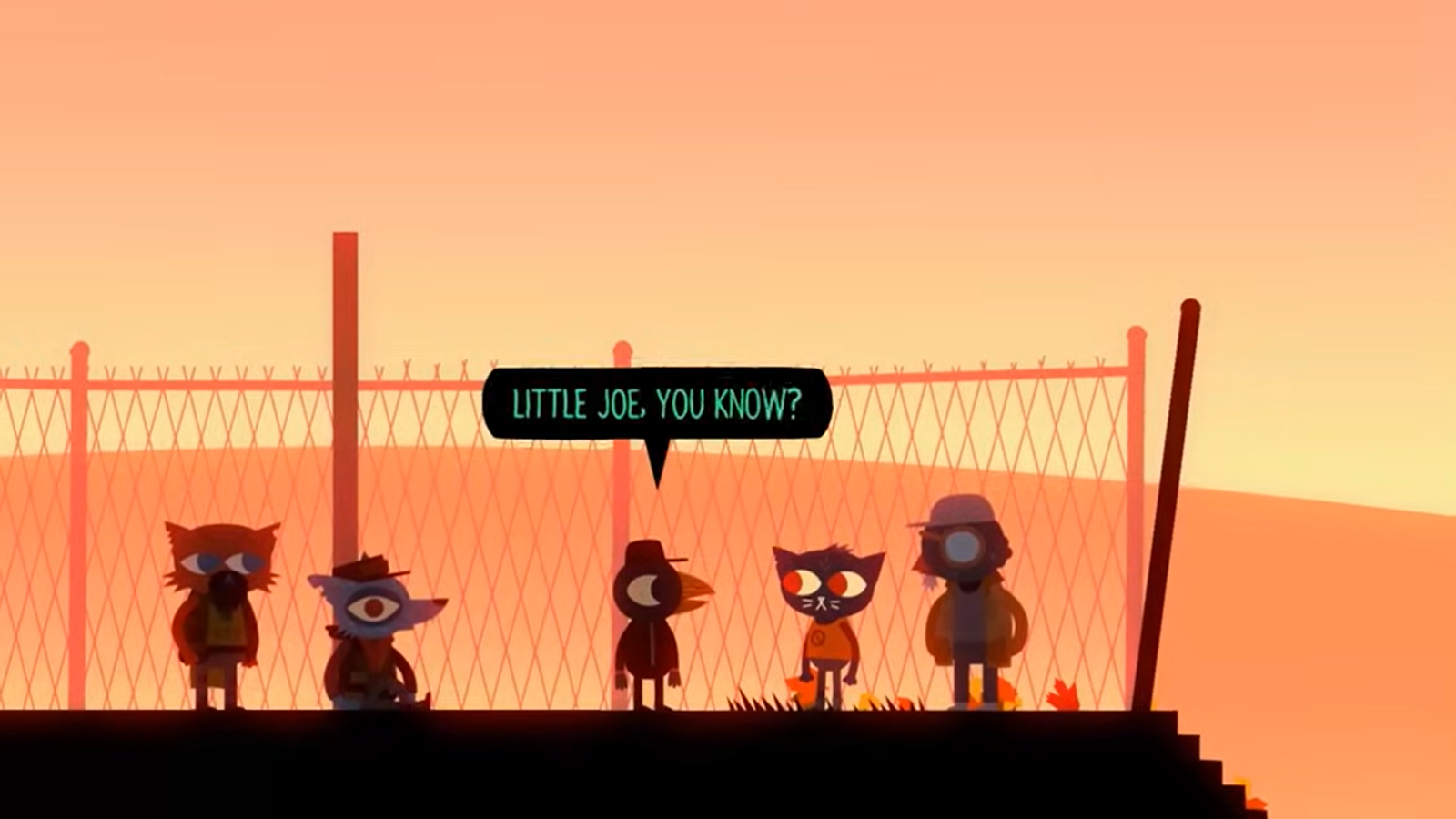
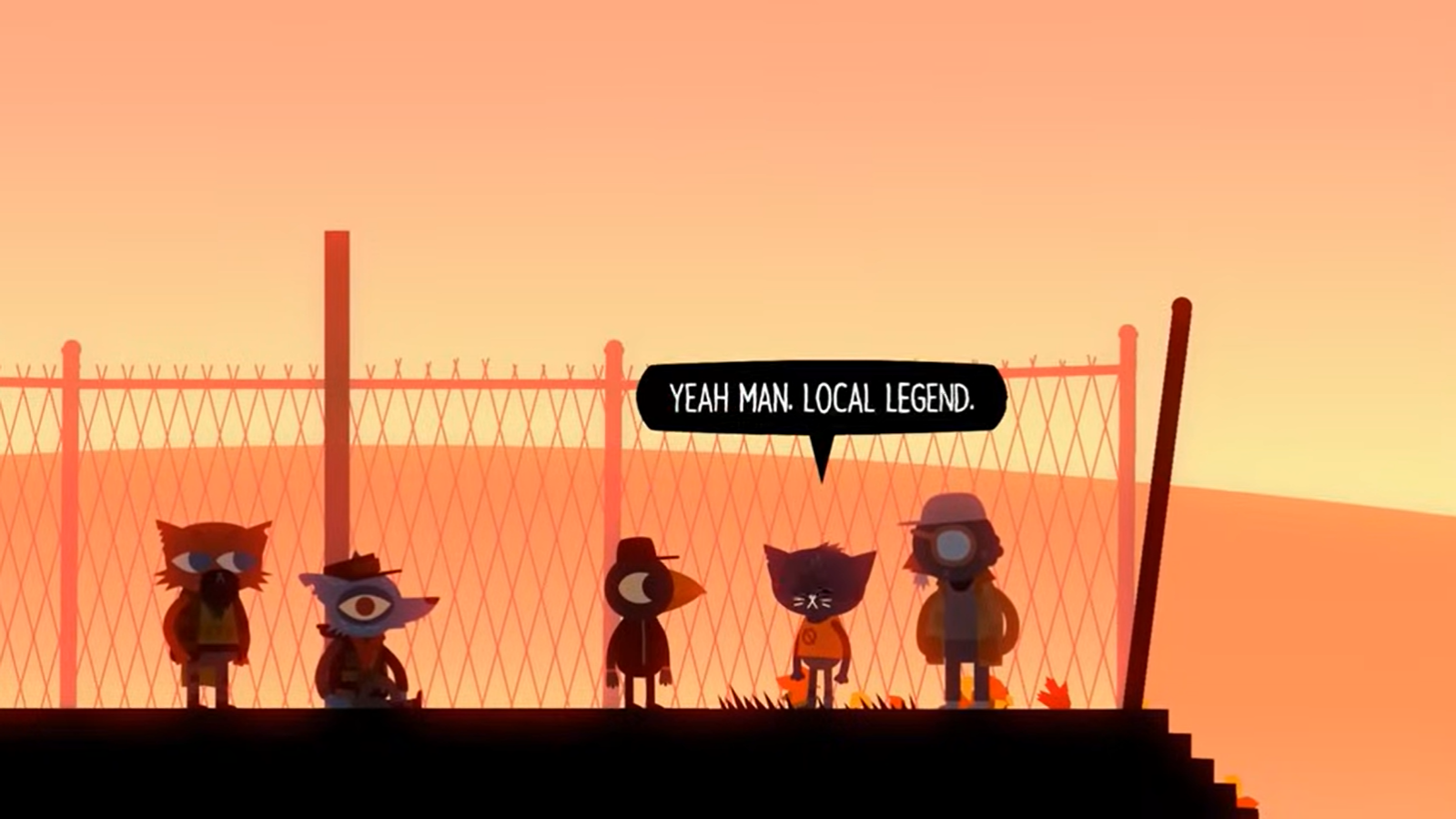
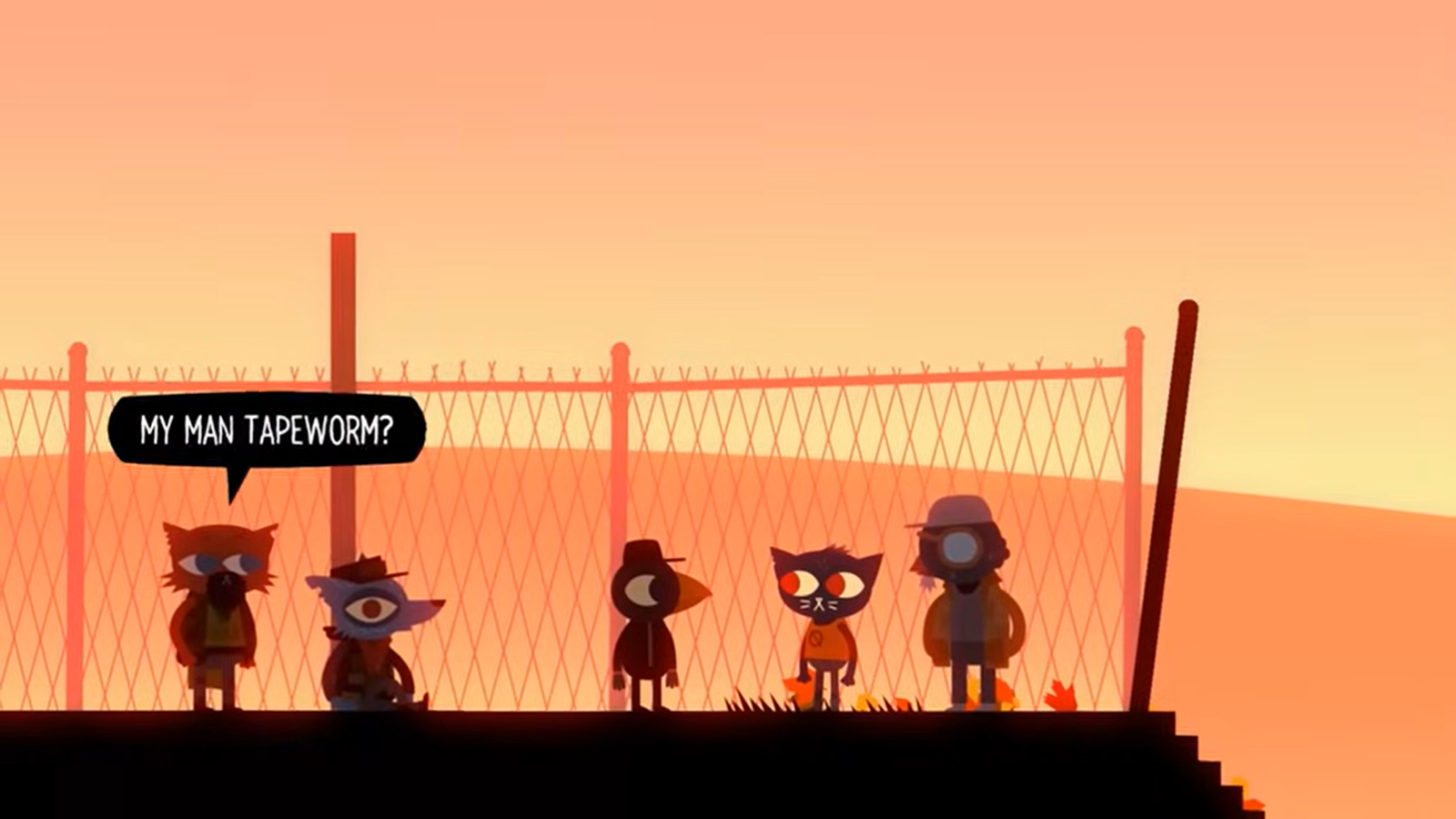
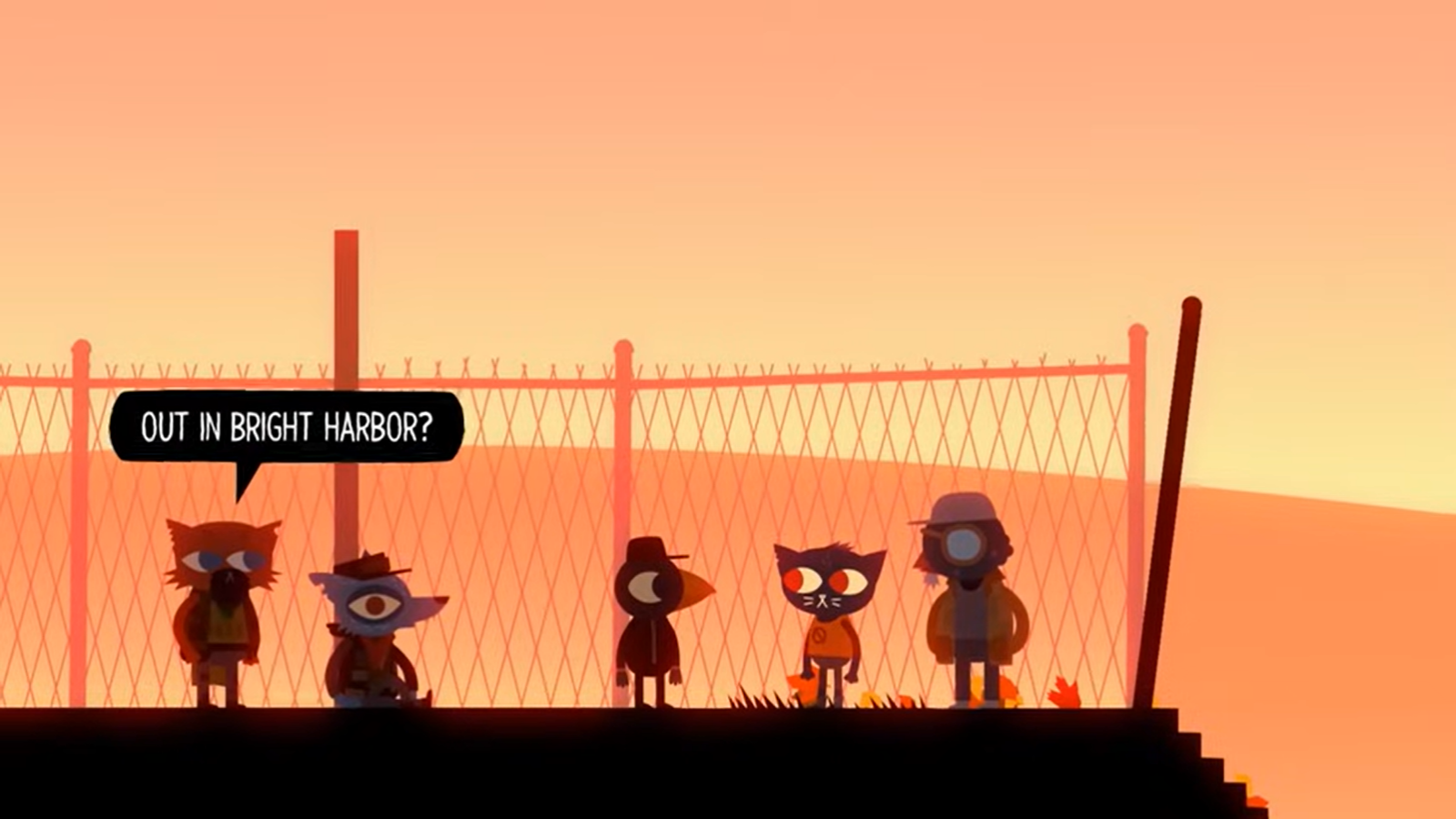
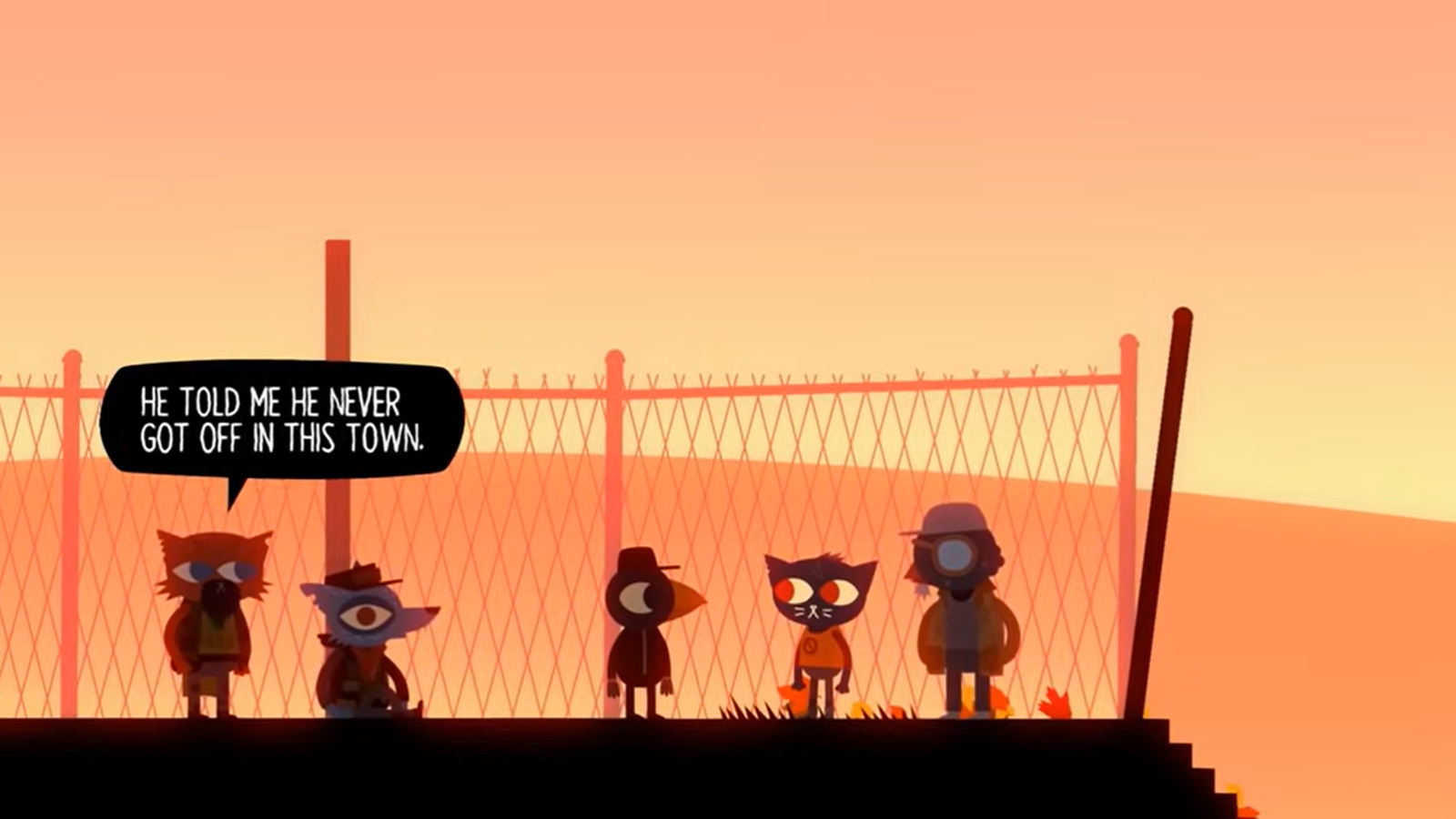
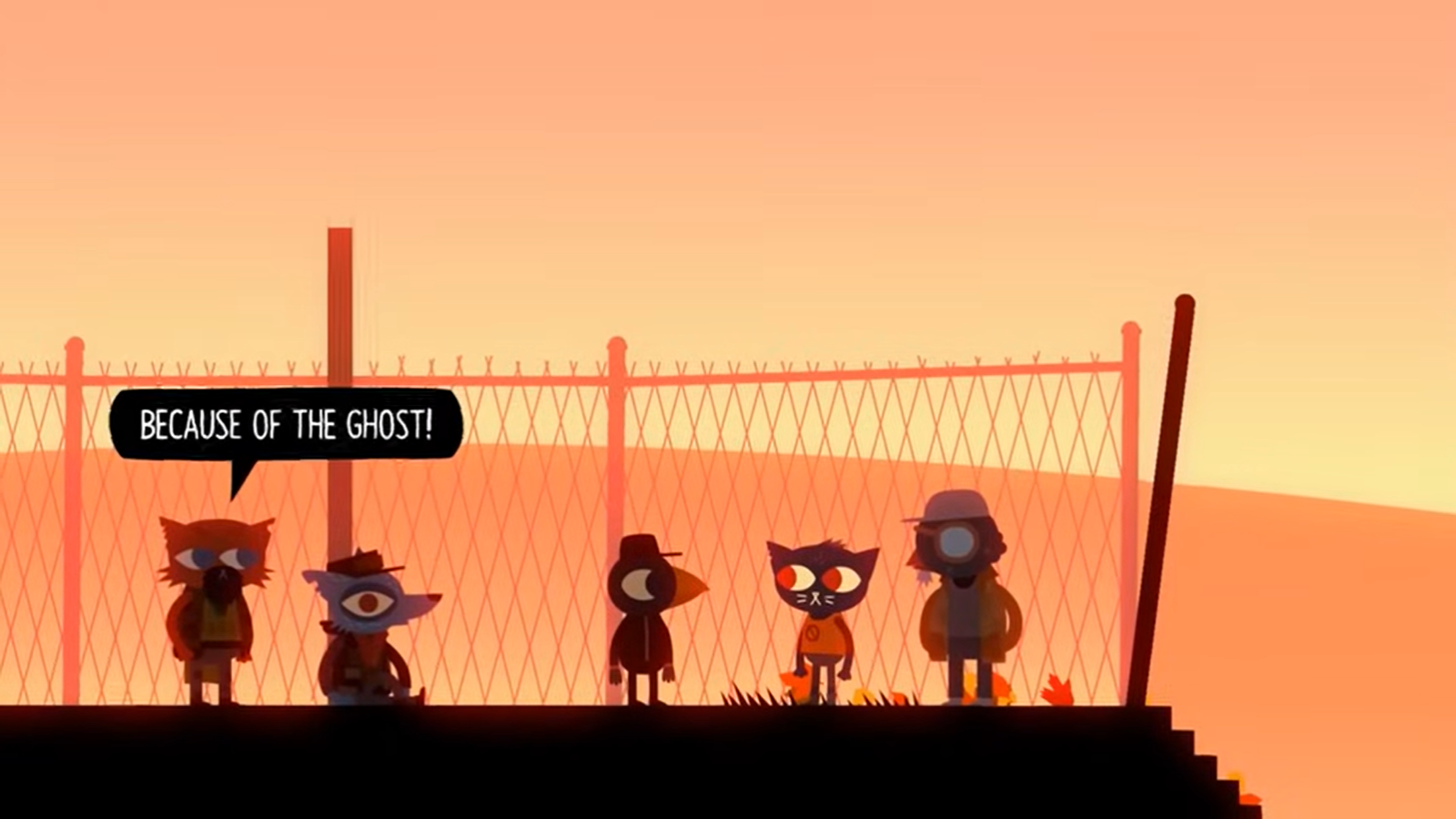
In addition, there is also the story of Possum Springs’ founding in 1793 by fur trappers, who run afoul of a witch who cursed the land after encountering the town founders. This is brilliantly shown in a play performed during the Harvest Fest, done by local actors who could really care less about it. I mean, look at these guys, aside from the coonskin caps they look like modern people.
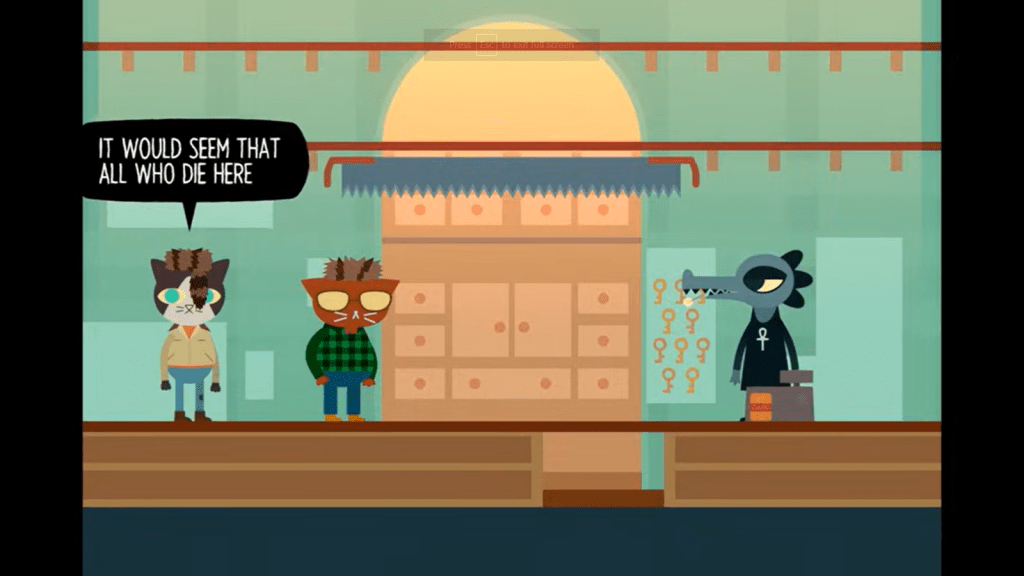
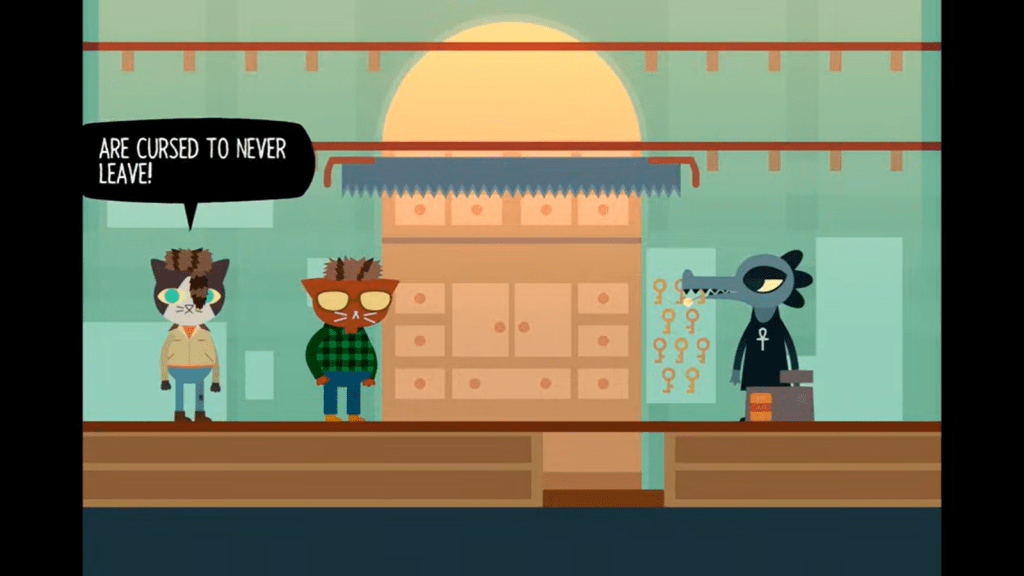
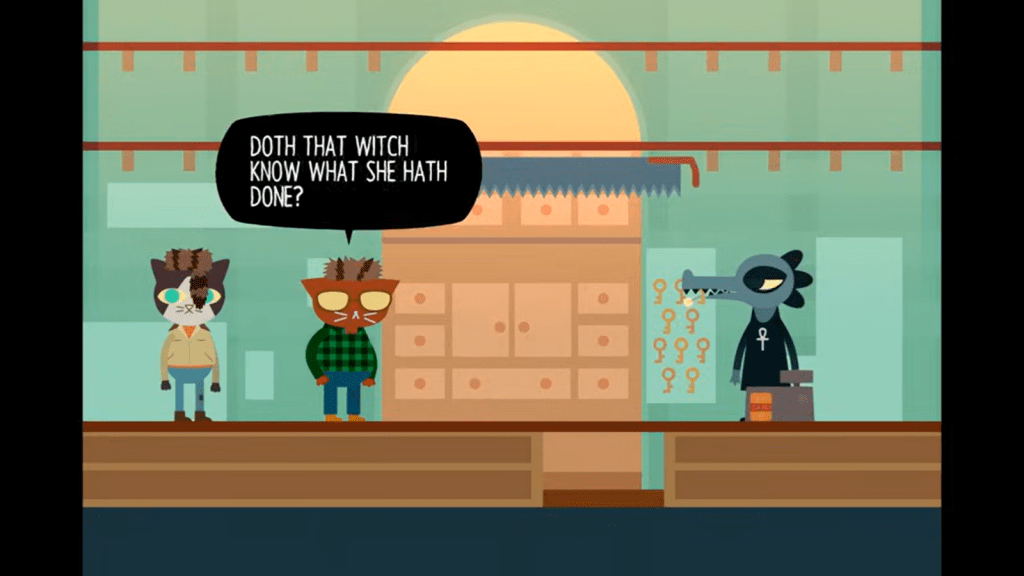
Following this brilliant show that should be on Broadway, the group sans Mae departs for their own things (Bea has to attend a dinner, and Gregg and Angus plan on spending the night together as a couple). As Mae stands there outside of the store, she witnesses something near the town statue.
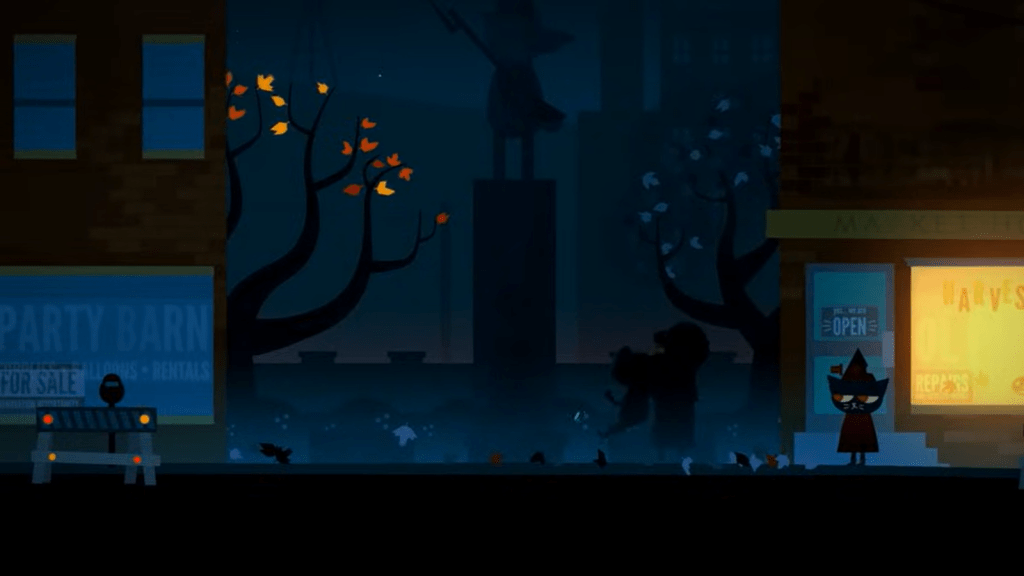
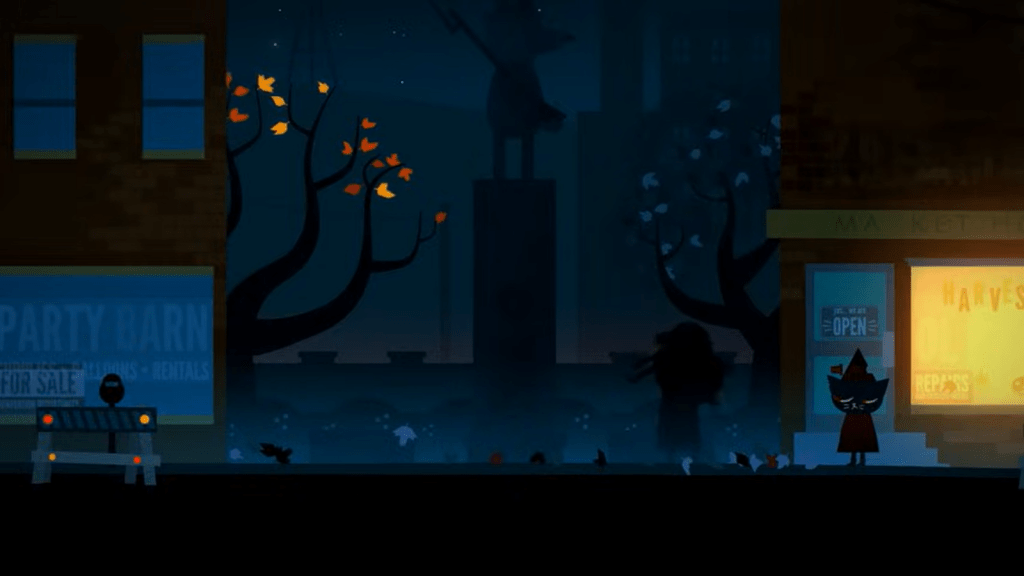
Seeing a murder happen is certainly something not a lot of people see every day, so Mae pursues the abductor (ab-duck-tor?) who manages to clear a fence in the time it takes Mae to catch up with him at the edge of town. But before you can pursue him any further, Mae’s aunt (who is a mall cop by the way) stops you.
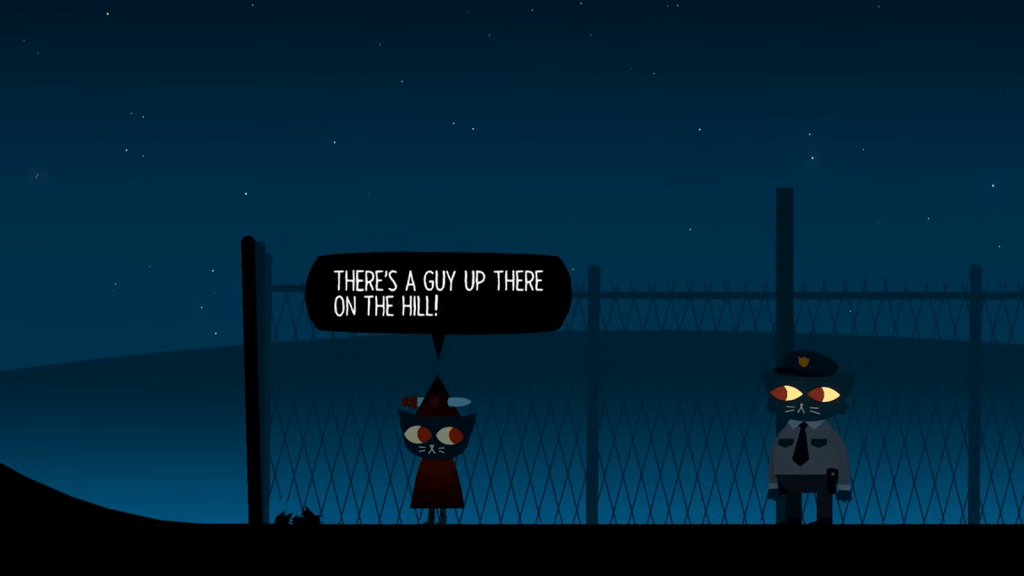
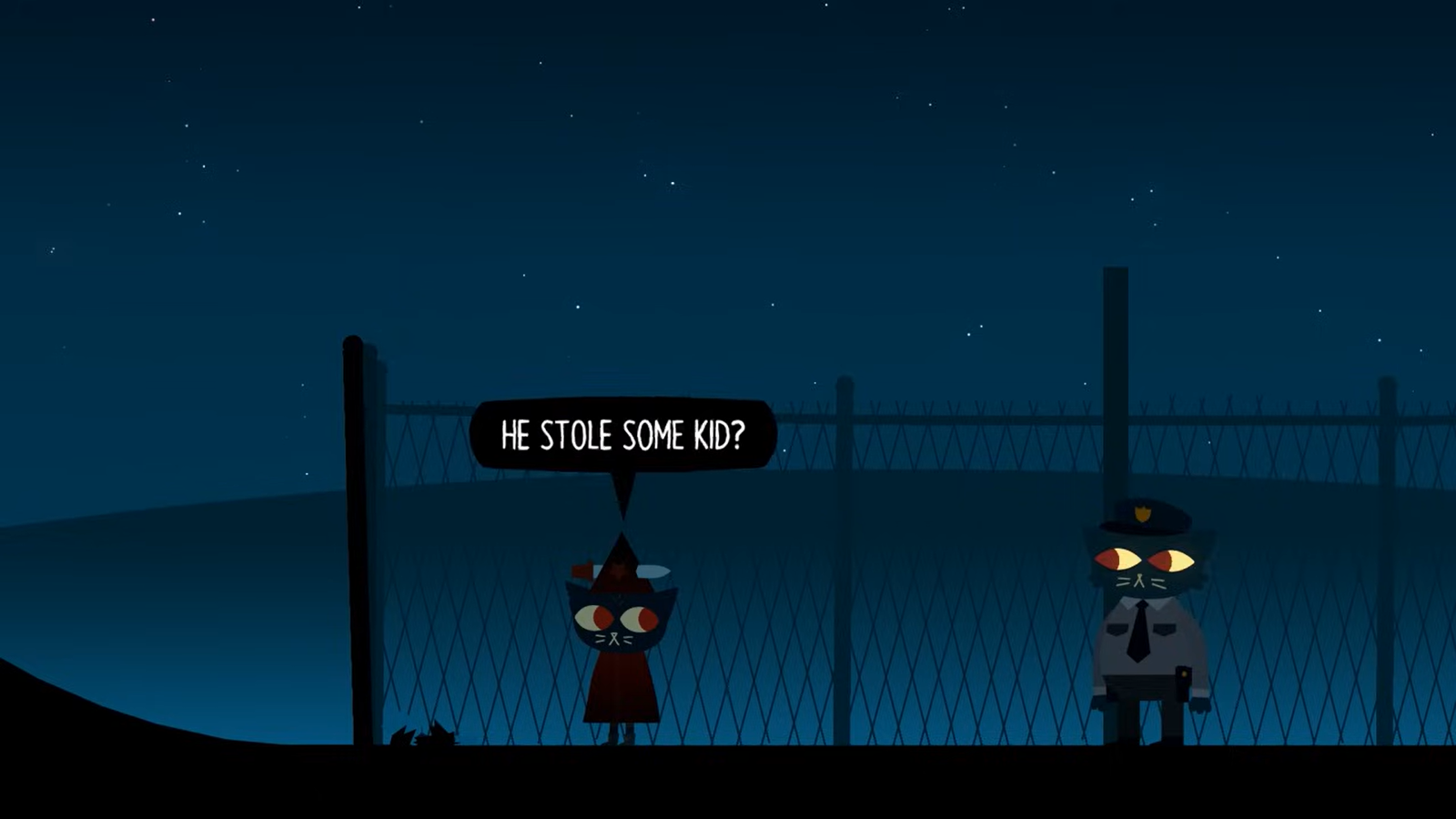
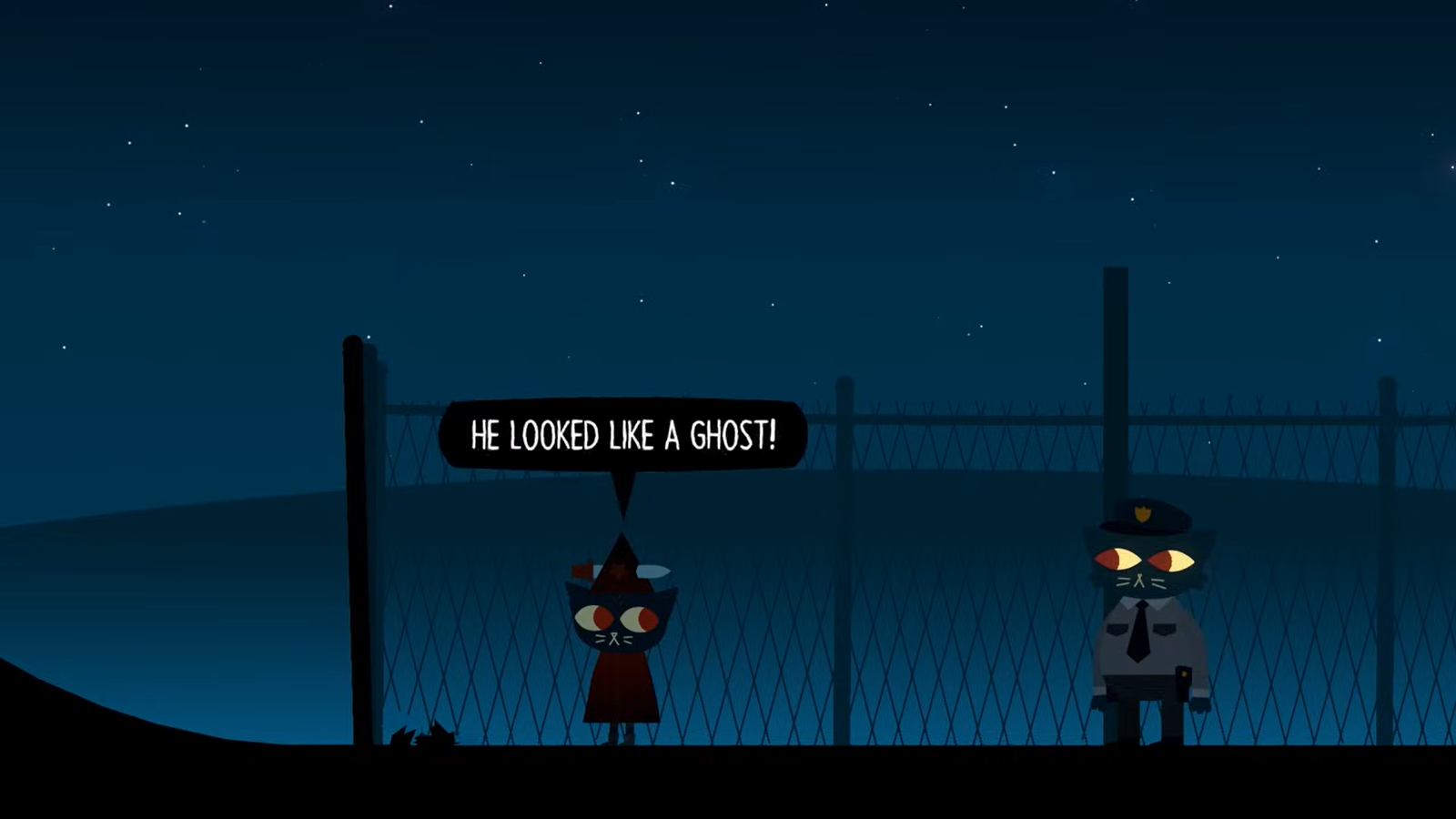
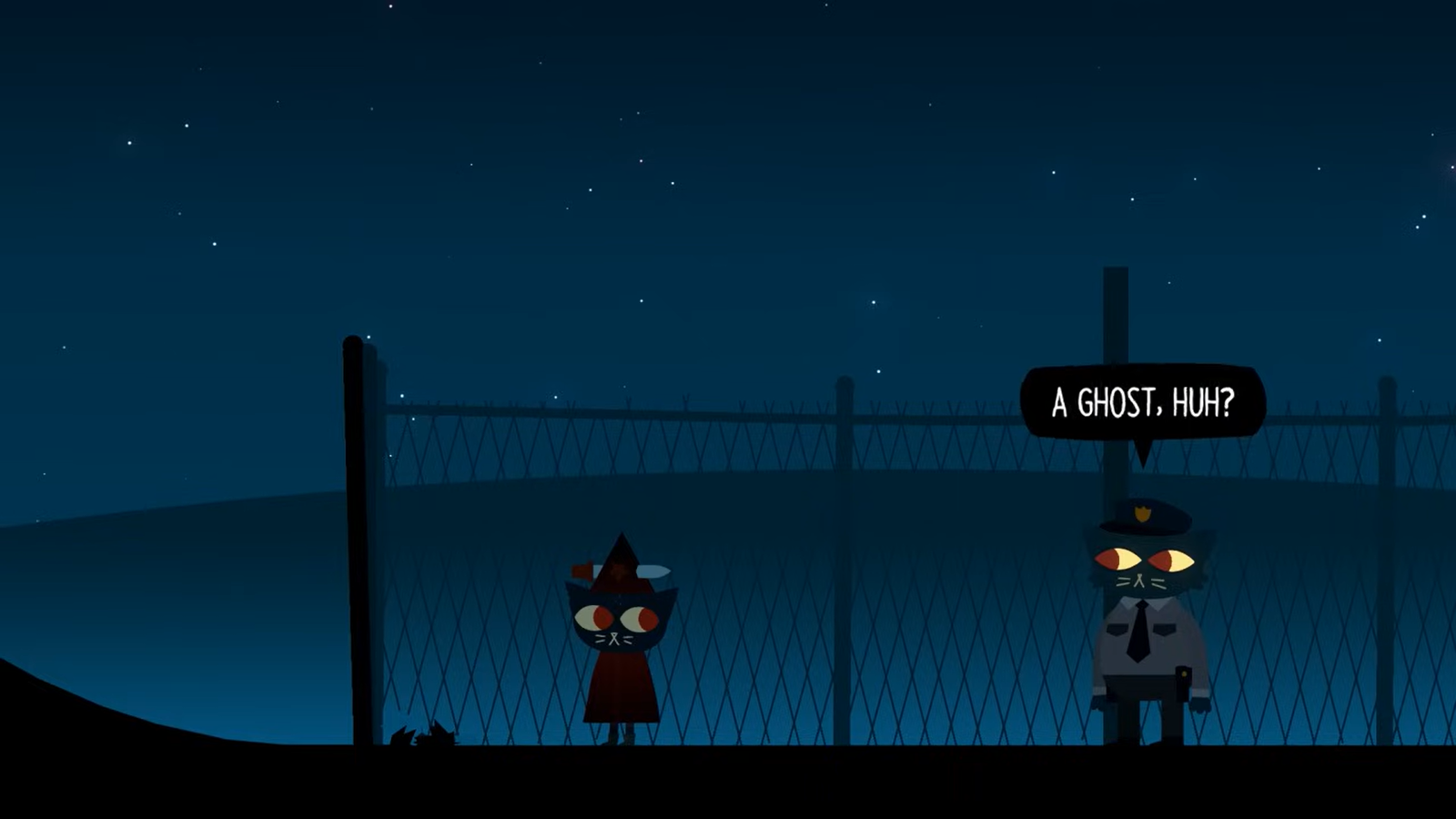
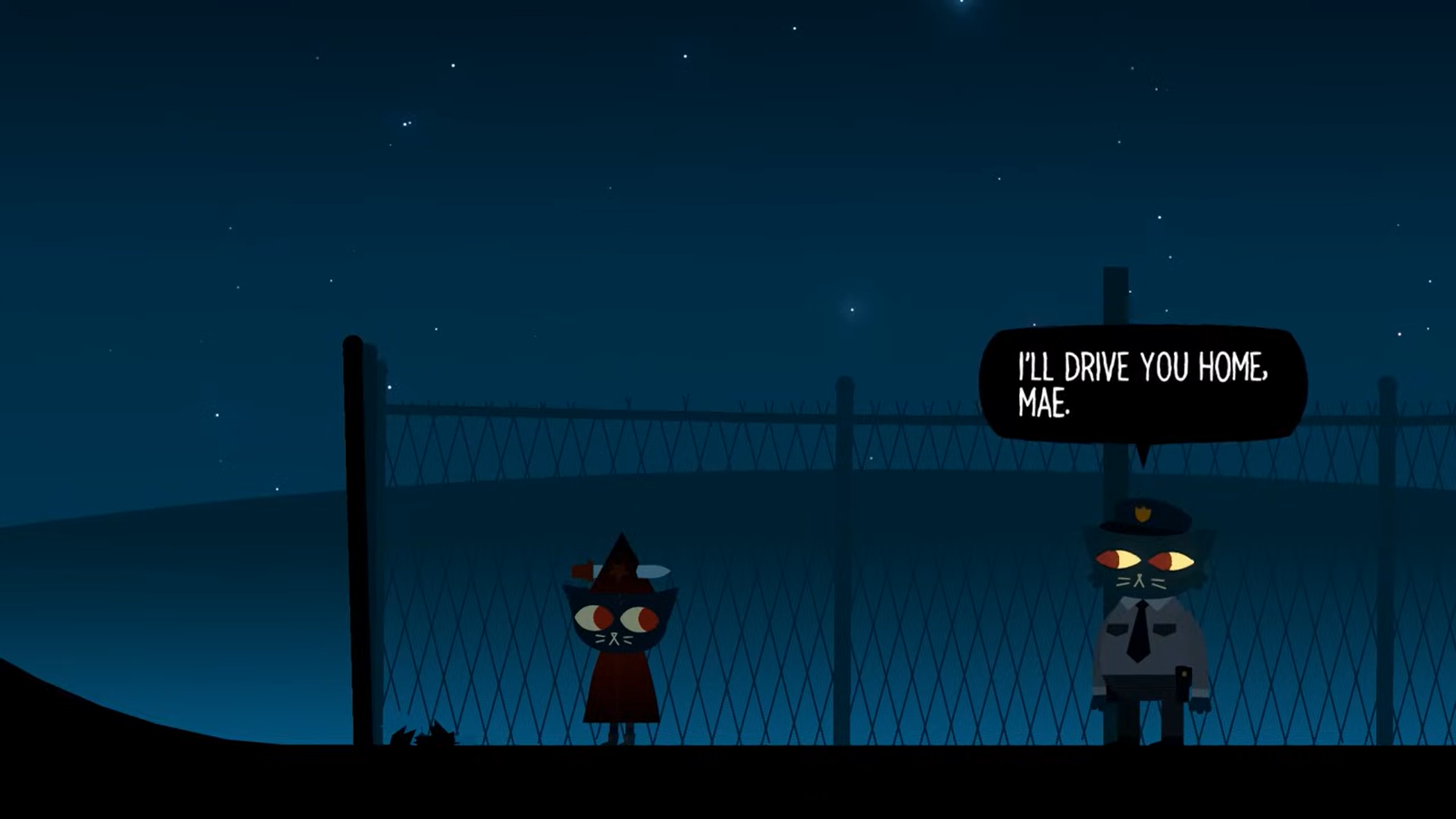
I will freely admit that I skipped a few parts of the conversation, but the point should be clear enough. Mae’s aunt does not believe her niece, which looking at this through a 2024 lens, is upsettingly accurate even if you ignore the fact that she’s a cop. Reluctantly, Mae acquiesces and returns to her home. The next morning, Mae meets with her friends and discusses the events of the previous night, as well as all of the dreams she’s been having.
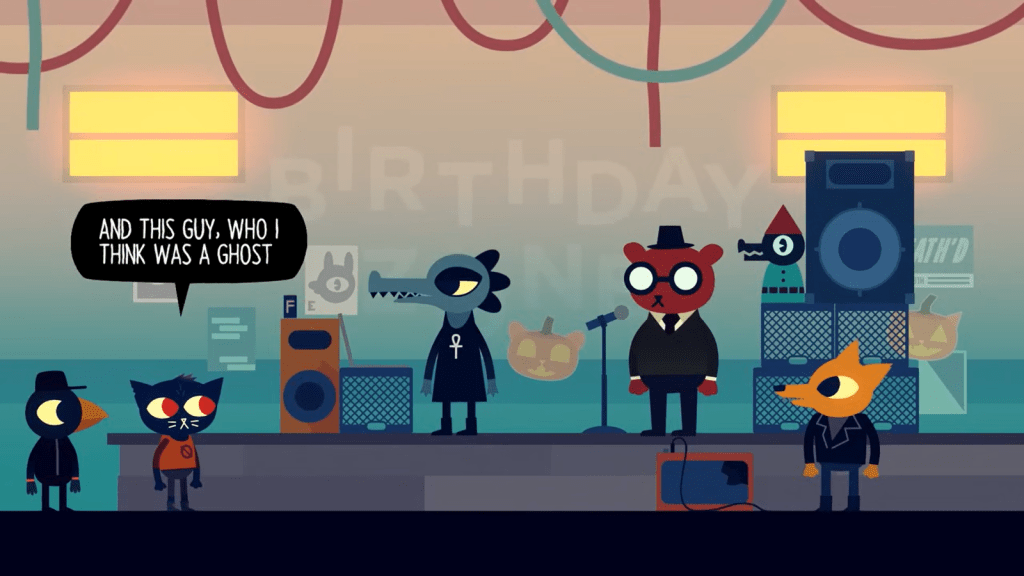
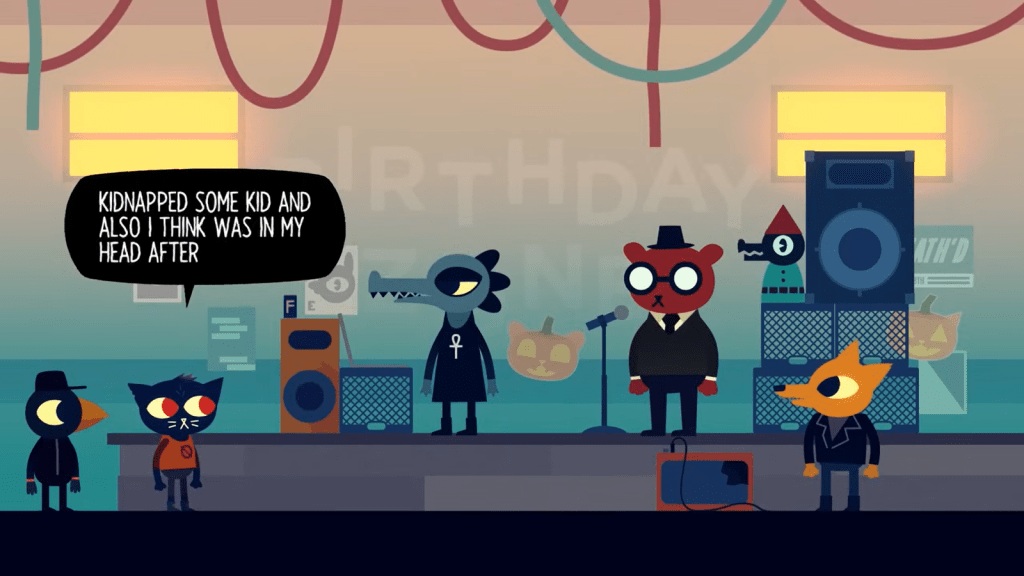
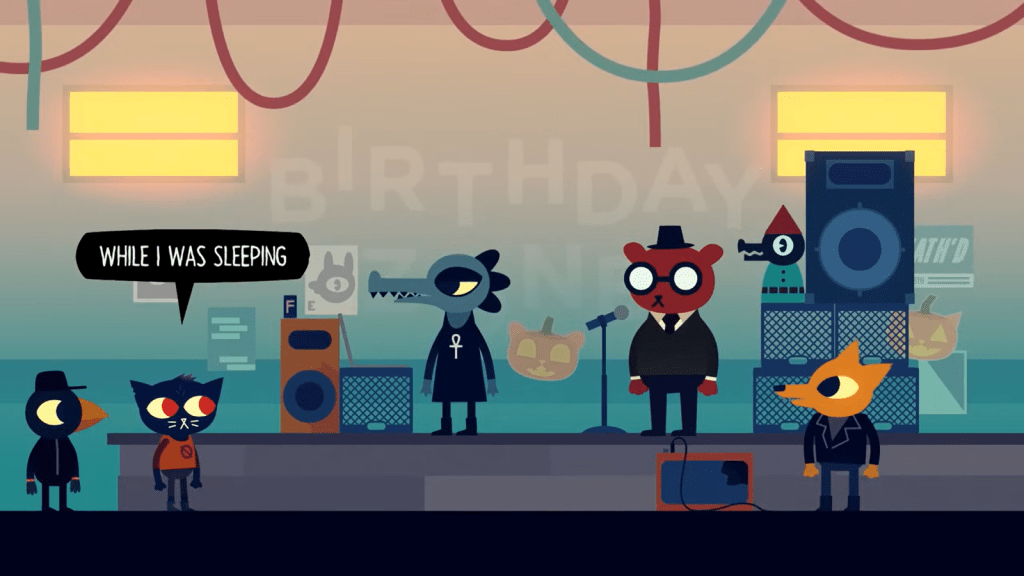

So with that, the plot thickens, Gregg, Angus and Bea all decide to help Mae check out locations around town to gain more info, with Gregg assisting Mae in a little B&E at the local historical house to dig up more info, and Bea taking her to the graveyard to find Little Joe’s grave. An idea that couldn’t have possibly gone wrong if not for the fact that they were being followed and the fact that sinkholes have made the hallowed ground of the cemetery unstable, which results in them unearthing Little Joe’s grave.
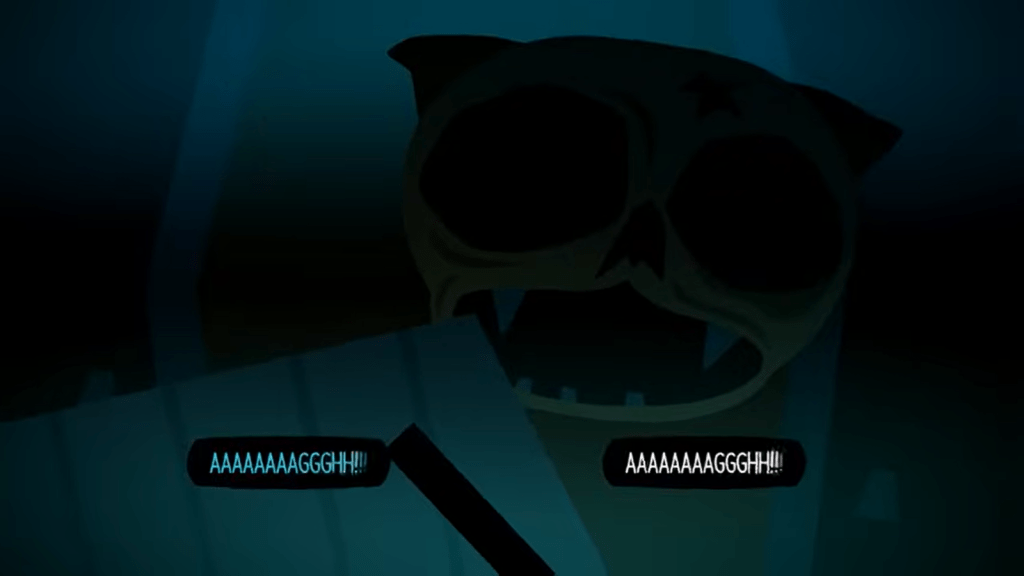
Yep, Little Joe was a cat person just like the Borowski’s and despite the local paper stating that he died under mysterious circumstances, there’s a hole in the upper right portion of his temple, which normally kills people. Would it be racist if I were to assume that Mae and Little Joe are related by blood? I mean as far as we know the Borowski’s have lived in Possum Springs for generations, and their ancestors could have been among the first settlers in the town. But I’ll stop here because I don’t want cancel culture to come for me.
Back in Angus and Gregg’s apartment, Mae and co. discuss what to do regarding this alleged ghost
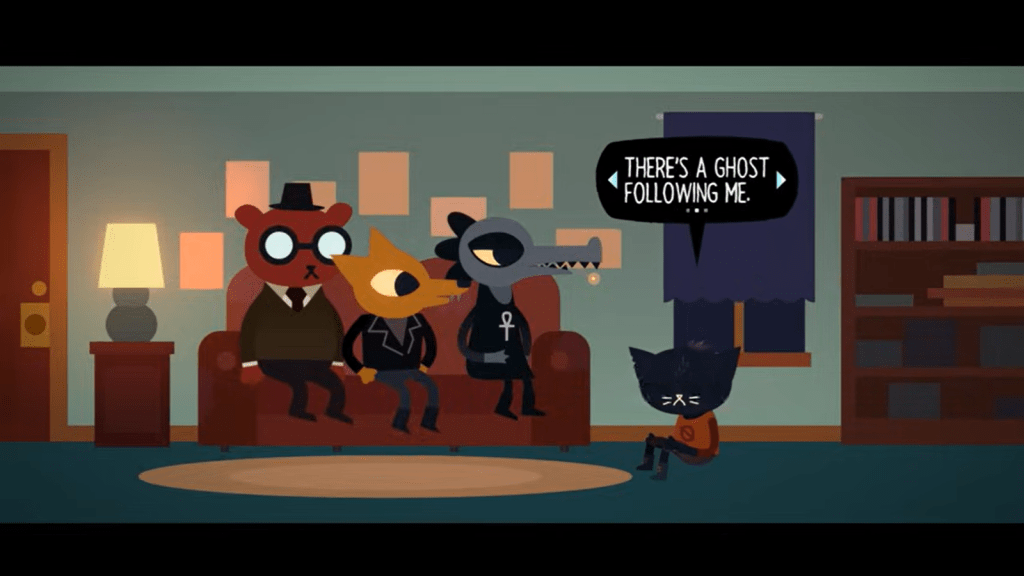
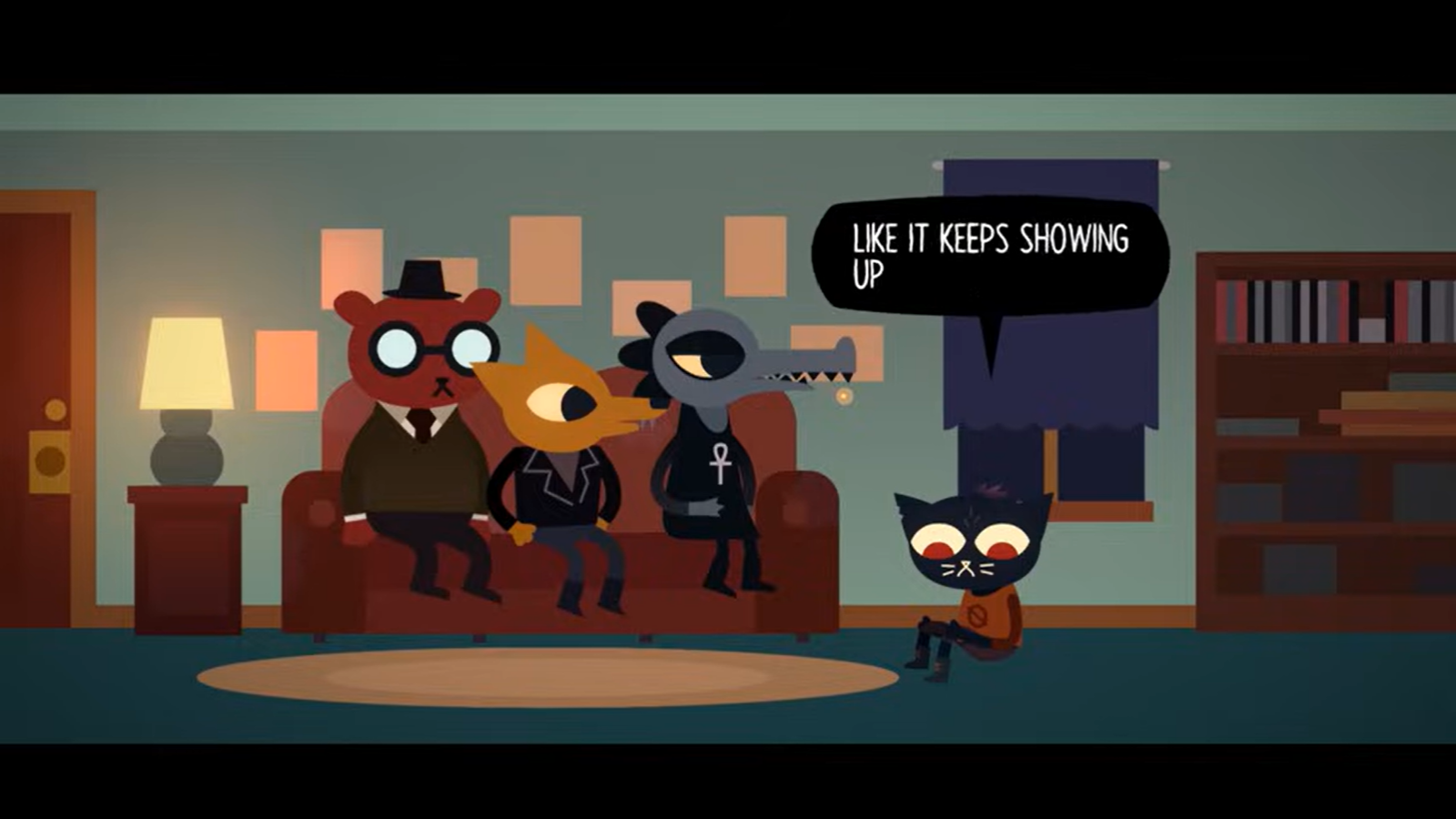
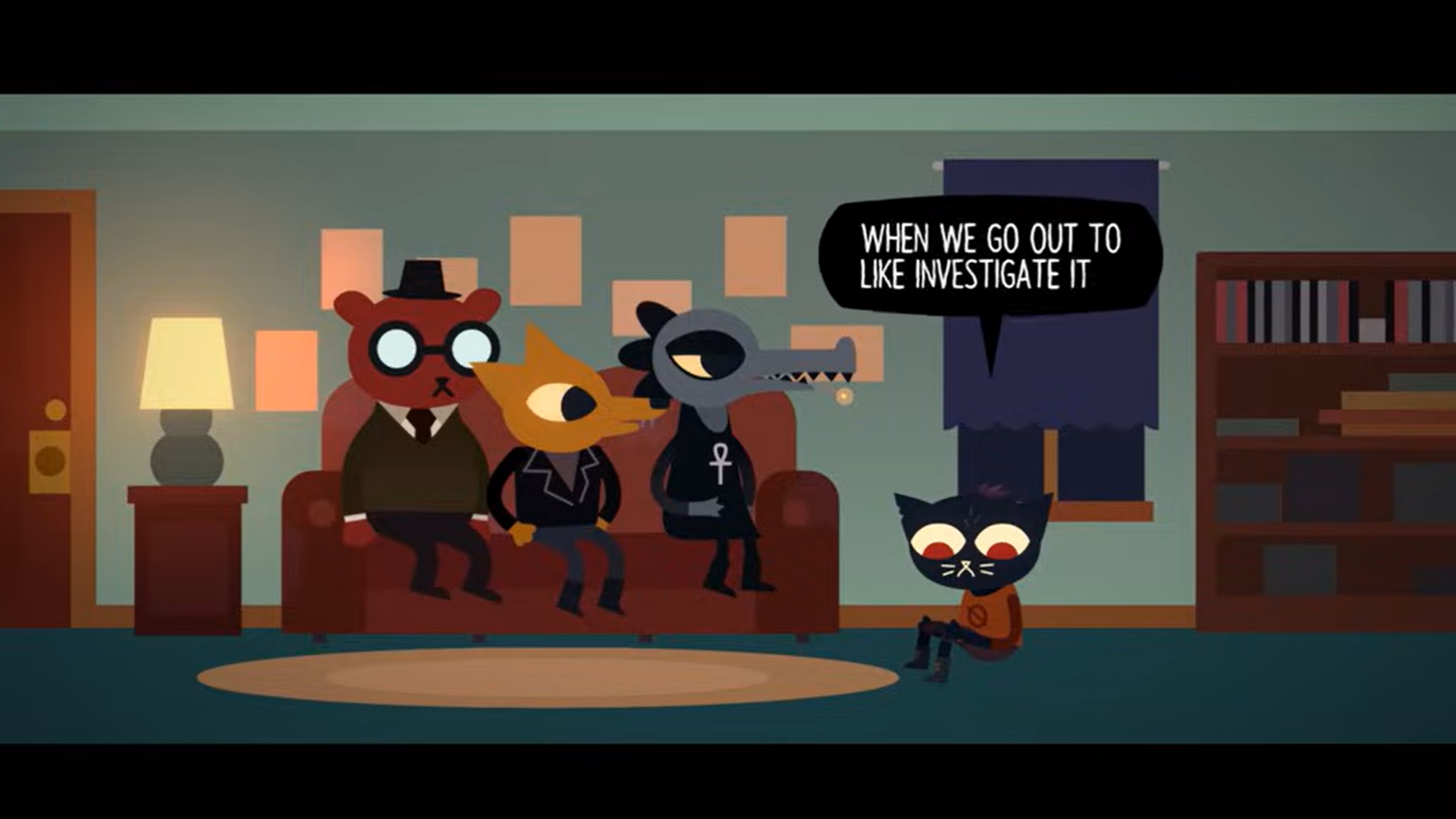
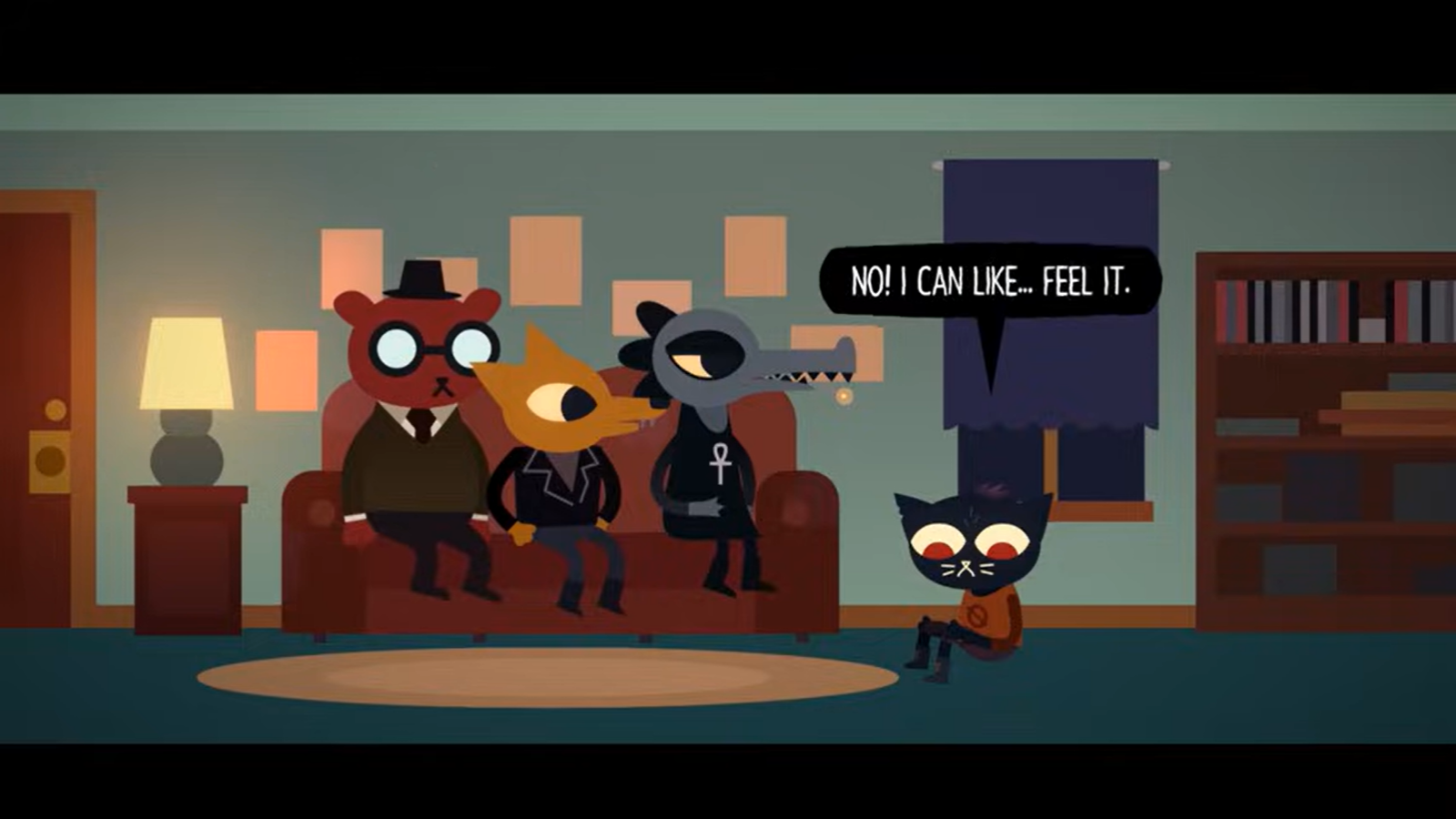
And while Mae wholeheartedly believes in the ghost, her friends are naturally skeptical of her claims and rightfully so. Mr. Cosmia and I chose scientific degrees, in disciplines that are built upon tenements of cold, concrete fact with little room for speculation. The Latin name for the Brown Trout is Salmo trutta for example, that is a fact and nothing can change that. The existence of ghosts is something that rests entirely on belief, you either believe in them or you don’t. Personally I have yet to see legitimate evidence of ghosts existing, and that makes my belief in it shaky at best, i’m a more “skeptical until proven otherwise” kind of guy. But ultimately there’s always going to be a part of me that wants to believe in ghosts and the afterlife… more on that later. Mae is understandably upset and vows to go alone into the woods at night, which is exceedingly dangerous. But she doesn’t have to, as all of her friends volunteer to join her in finding out the truth.
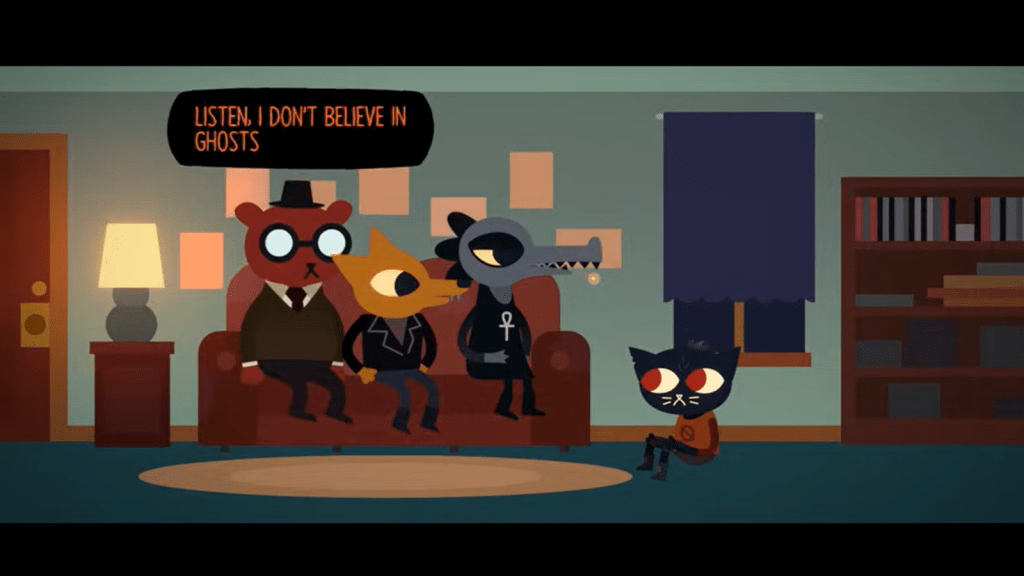
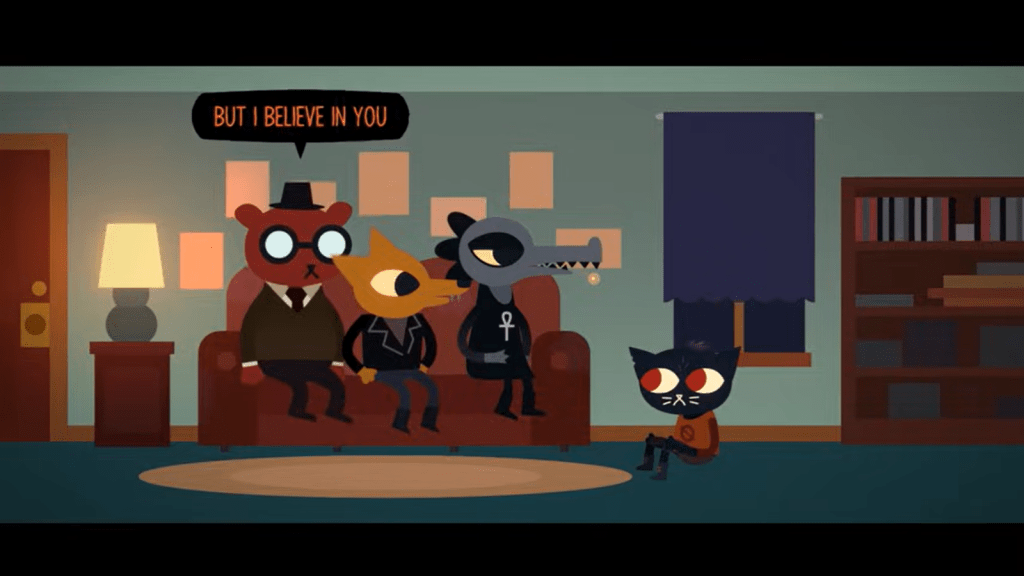
Angus puts it beautifully by the way. Ultimately the group treks out into the woods down towards a cave where they encounter a grisly sight: A group of hooded folks with a person shaped bag.
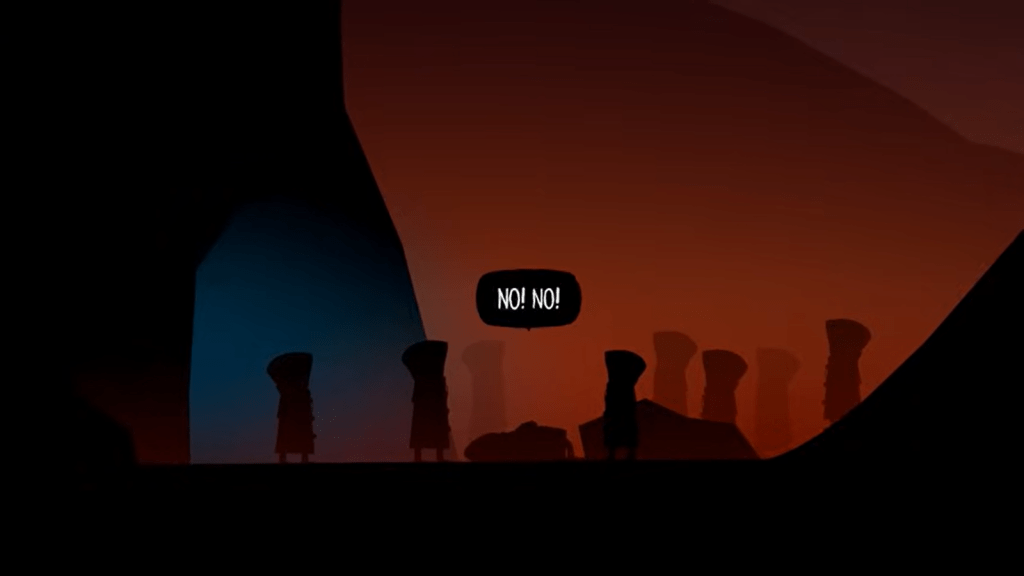
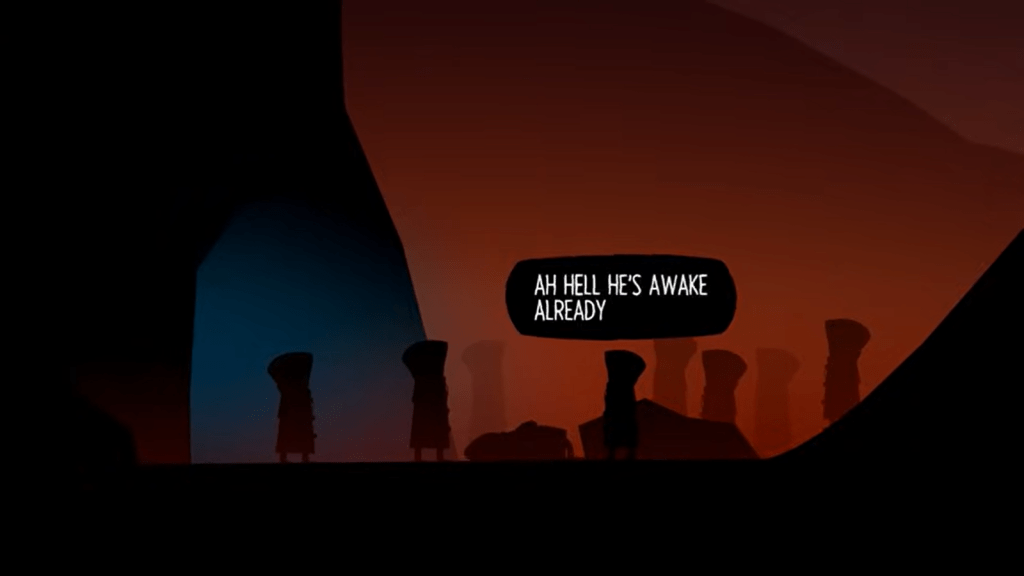
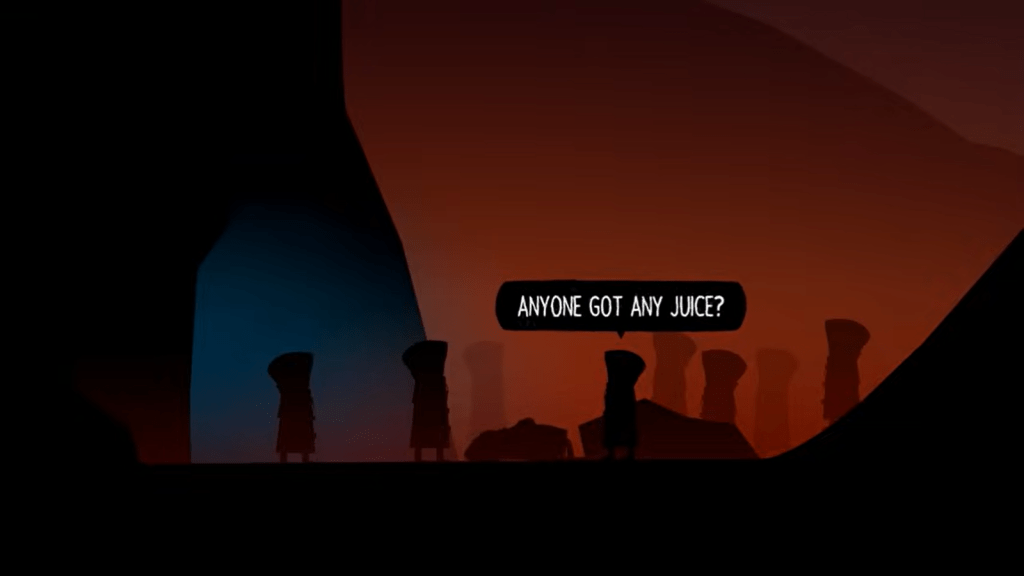
After a while of the hooded figures discussing their plans to presumably do away with their former companion, they’re alerted to Mae and co., who are witnessing this all happen on a nearby hill. Knowing that the hooded cult is going to presumably put them away for good, Mae, Bea, Angus and Gregg book it back to town,
But then Mae trips and falls off the hill.
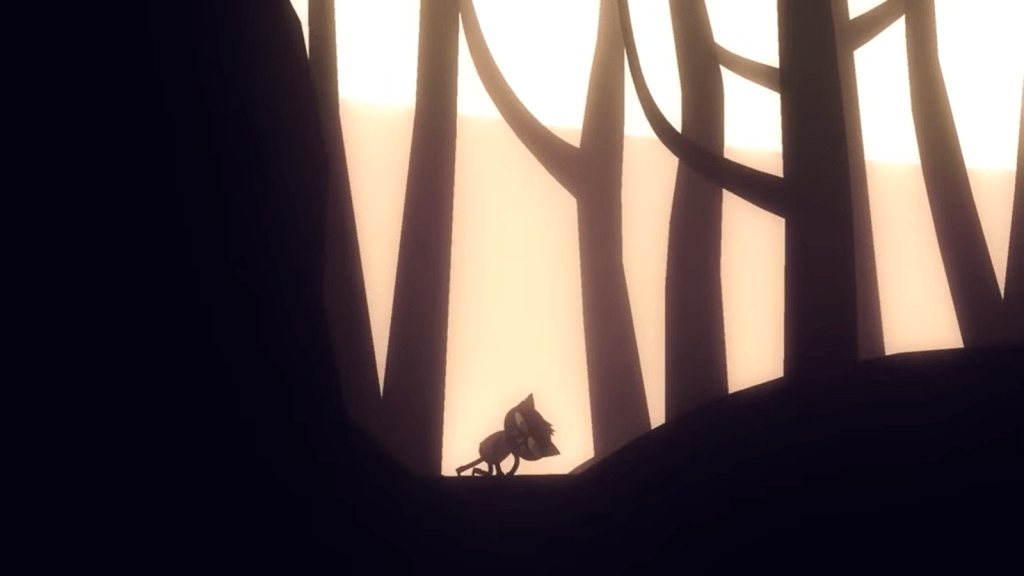
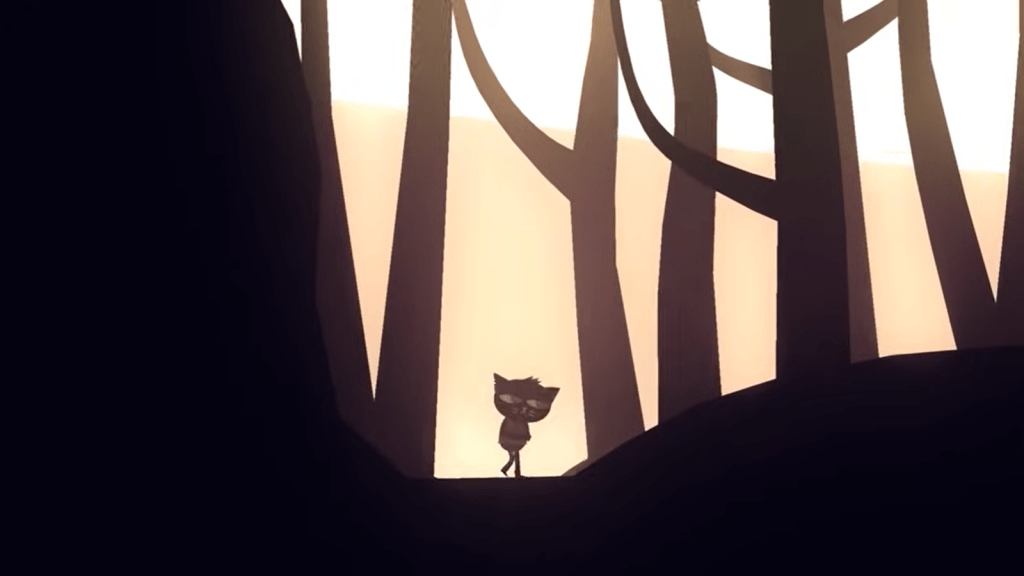
I guess cats really do land on their feet, Mae stumbles through the forest for a bit and then collapses, and then the scene cuts to the church, where Mae’s friends and parents gather around their fallen child/friend/nuisance. I say nuisance because the crotchety old crocodile really seems to have it out for Mae

But thankfully, it’s a fake out, Mae is alive but not well because she still has to deal with the cult that convene in the mines. She elects to head back down there and find out what the hell is going on.
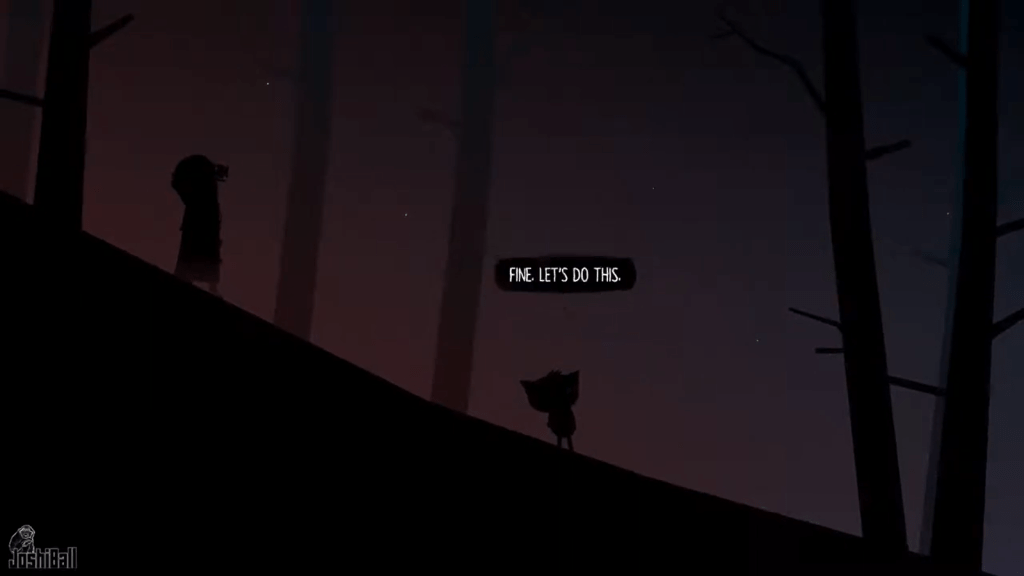
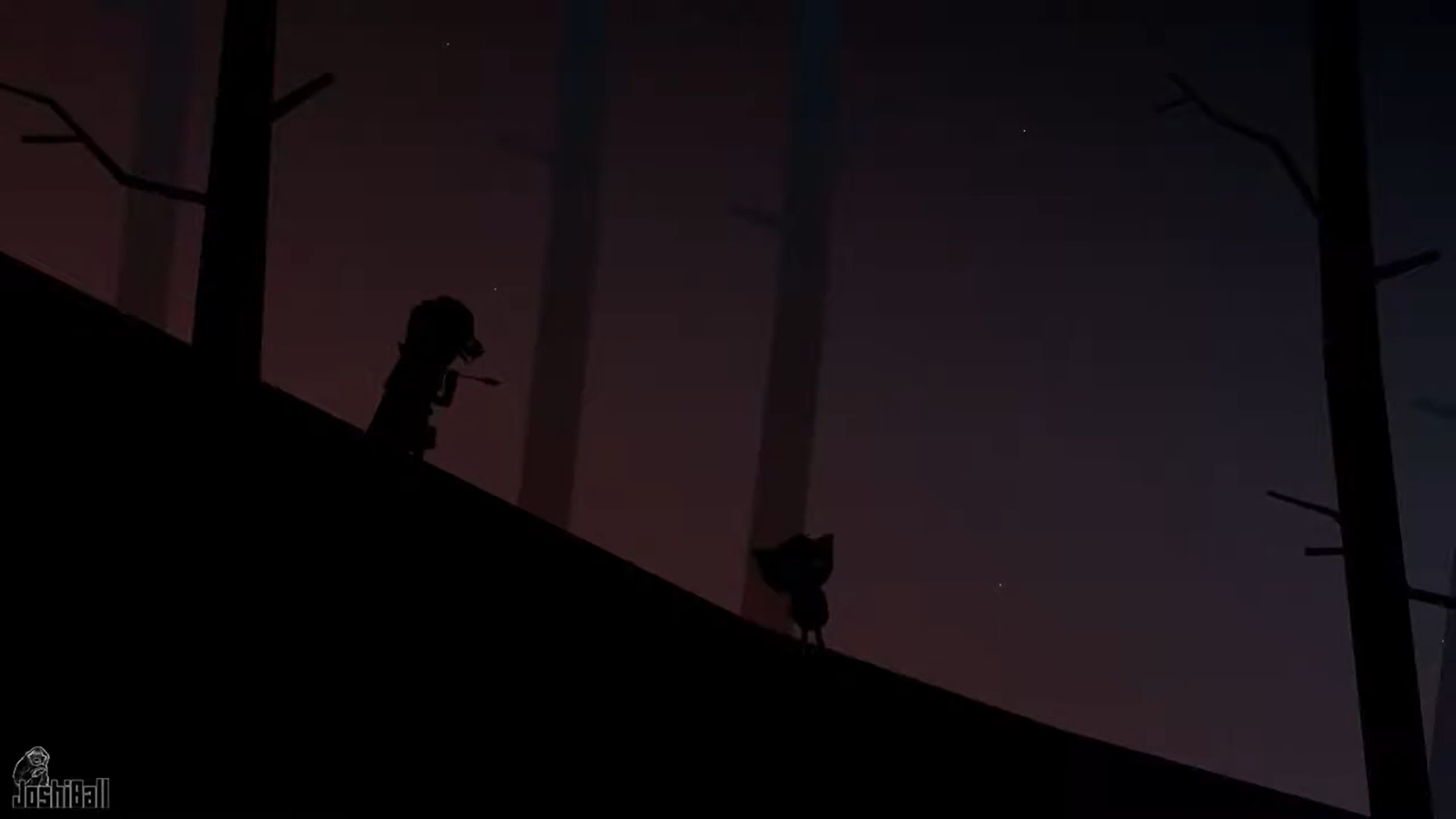
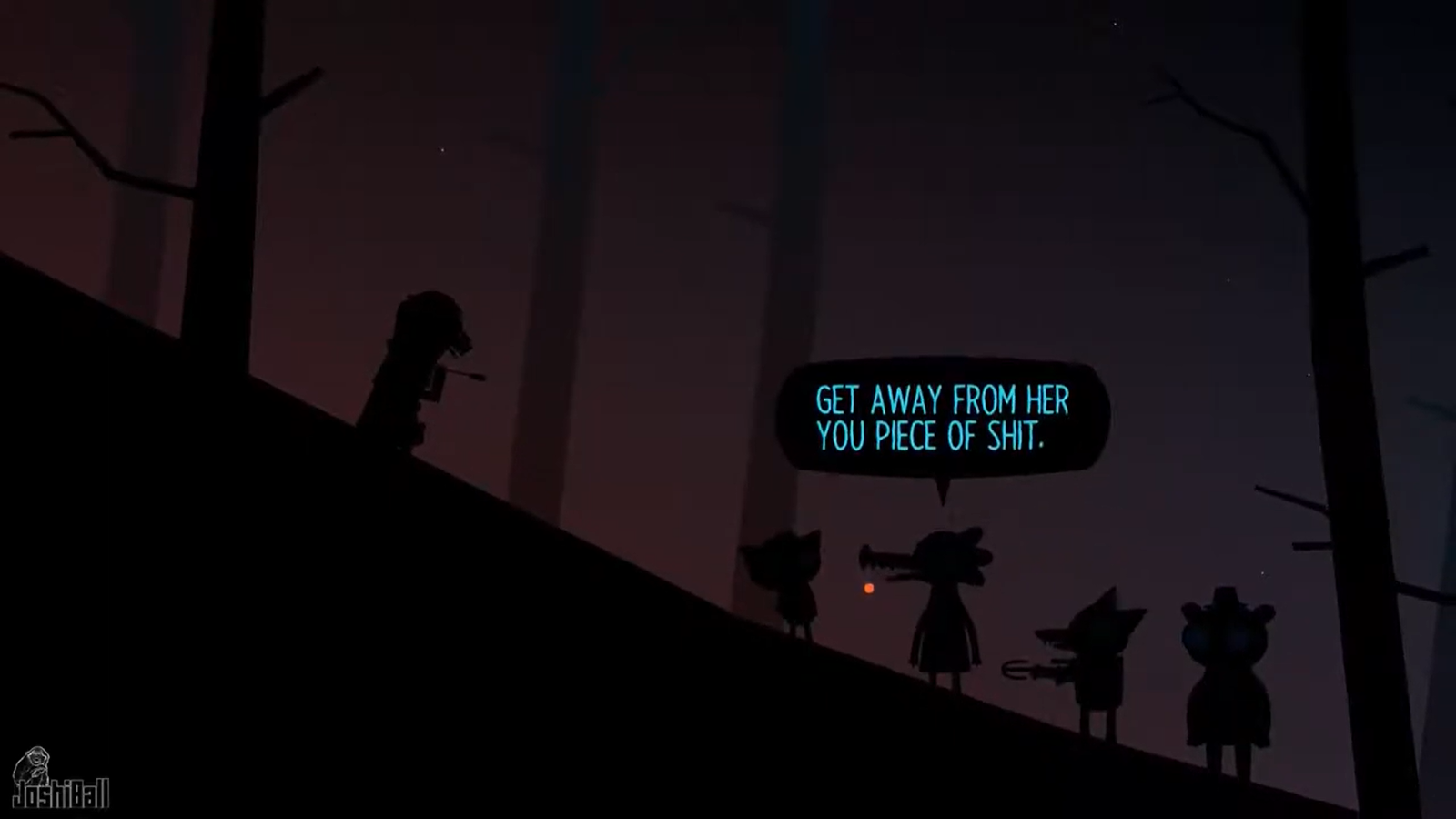
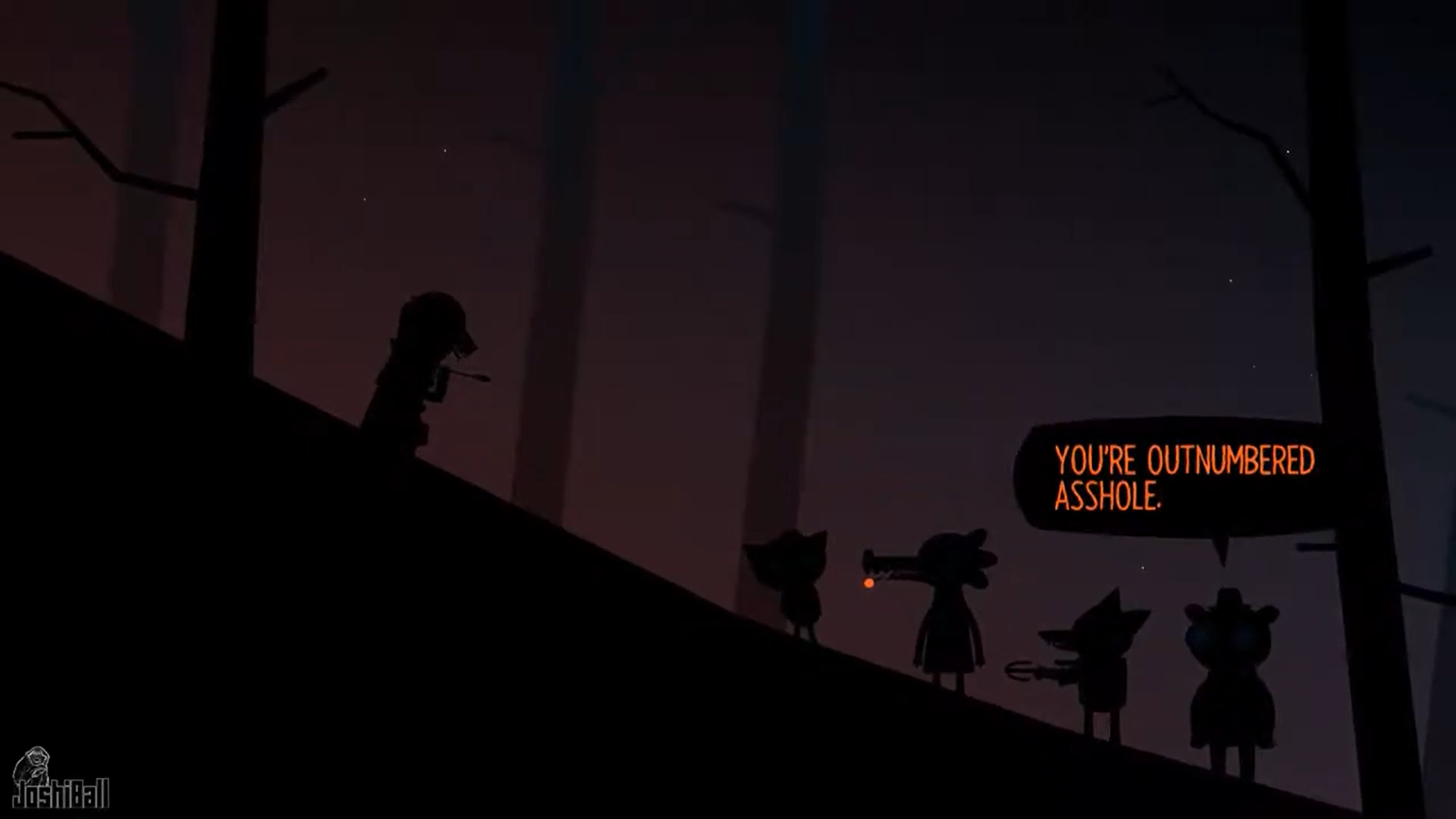
Thankfully, Bea, Angus and Gregg arrive just in time, armed with a crossbow that Gregg fires into the hooded figure’s shoulder. Wounding the “ghost” they exchange a bit of banter and pursue it back into the abandoned mine. But just when they think they’re dealing with one hooded figure, the lights in the cavern turn on, revealing the rest of the cult. Is it right to call them a cult? Whatever, ill do it anyways.
The red cloaked cult member that was shot demands that they deal with Mae and friends, but another one acknowledges Mae herself was shot by them, so they’re even. Mae skips to the point and demands an explanation, to which the hooded figure obliges, revealing their true purpose.
This group of individuals was growing frustrated by the declining state of Possum Springs, and the church wasn’t helping them find the answer. They were looking for a solution when they found “it” in the deepest part of the mine. What “it” is is left ambiguous, but the cult describe it as a god, which sings songs that only they and Mae can hear. After discovering the pit with the god in it, it offered them a deal: Possum Springs will prosper so long as they continue to feed it, the food in this case being sacrificed people. They had one ironclad rule though, to not take anyone who would be missed, meaning drifters, homeless people and those without any relatives were fair game.
Do I want to spoil the rest of the game? not really, because the way it actually ends has to be seen to be believed in my opinion. Though I will touch on one main theme that I noticed in the next section.
The Theme
Throughout TNITW there is a subdued emphasis on faith, and how it plays a role in the lives of individuals. Possum Springs is largely based around small rural towns in America (presumably Midwest, as it was a mining town at one point) and a good portion of them have churches for the community to gather. Back in the 1800s churches were a very common sight in such small towns and lives revolved around it. Everyone went to church on Sunday, you were married at the altar and buried in the cemetery nearby, with wrought iron gates wrapping around the yard. And to a lot of people, faith in their religion was what gave them purpose. It reassured them that everything would work out, that a higher power has plans for them. And to so many people, that was enough.
But in this modern age in which we live in where we’re more connected than ever before through technology, church simply doesn’t have the ability to pull people in the way it used to. You can live your life independent of religion if you choose to, which a lot of people (myself included) have elected to do. Without getting too personal, I used to be Roman Catholic, but in my own words “not a very good one”. I was baptized, had my first communion and attended CCD (basically Sunday school but on mondays). I used to hate going to CCD, because it started immediately after regular school and wouldn’t end till 7 PM at night. Eventually, I was able to “drop out” and didn’t have to attend anymore, and that was that. The only downside as far as I could see is that I can’t be married in a Catholic church, but that doesn’t really matter to me I want to get married someplace fun, like Seaworld! My bride will come in on a sea chariot pulled by belugas and penguins will be my best men or something crazy like that. Eventually I went the route of studying general biology in college, which to most Catholics is a big no-no, but what do I care? it’s my life and if that makes me an enemy of Catholicism so be it.
I can see a lot of myself in Mae, because she too doesn’t really believe in anything. Despite her mother working for the church, she doesn’t seem all that interested in faith, but doesn’t seek to ruin other’s beliefs. But she’s quick to call out hypocrisy when talking with the pastor, who reveals to Mae that she herself doubts god’s existence, stating “It’s your job to believe.”
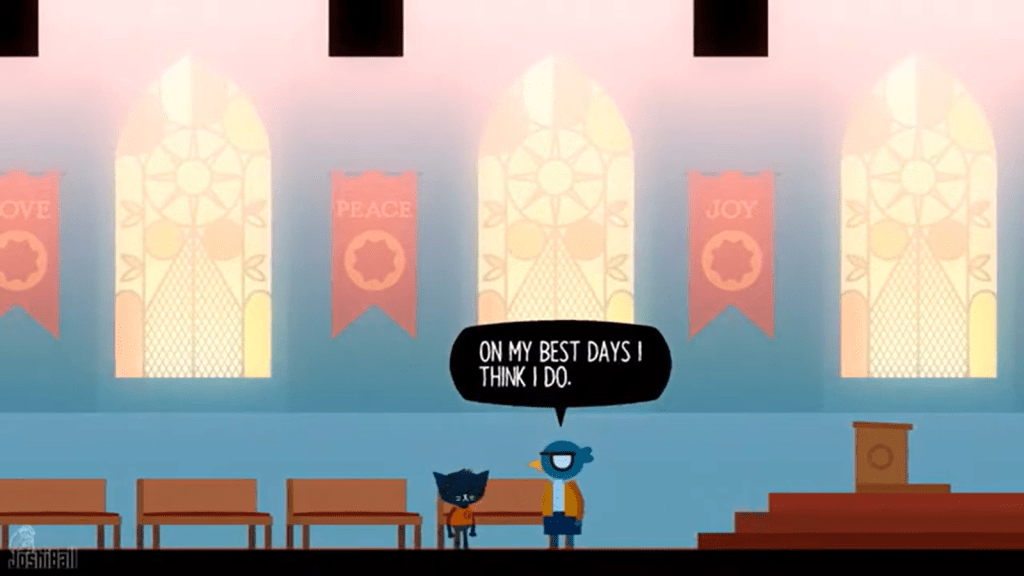
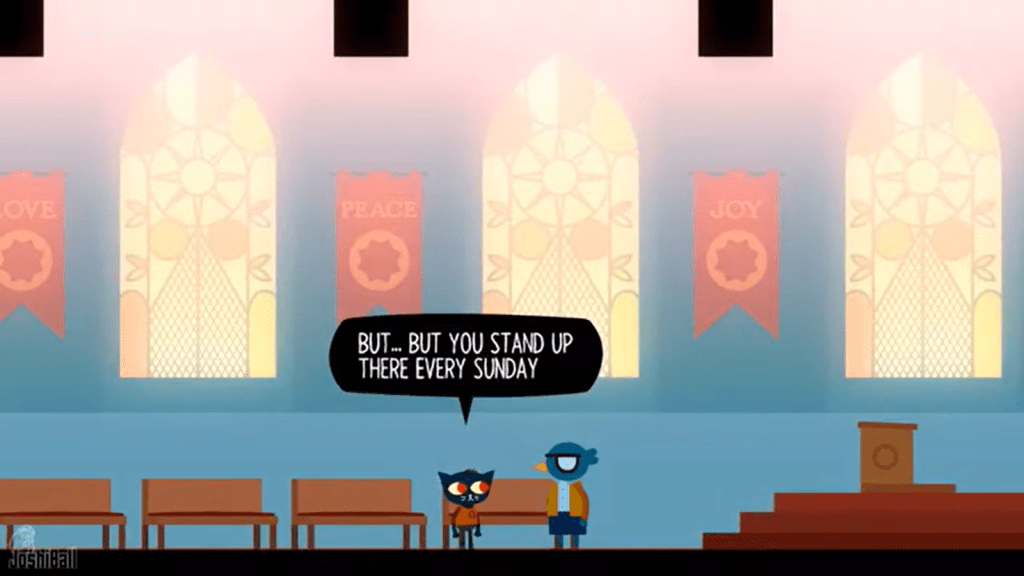
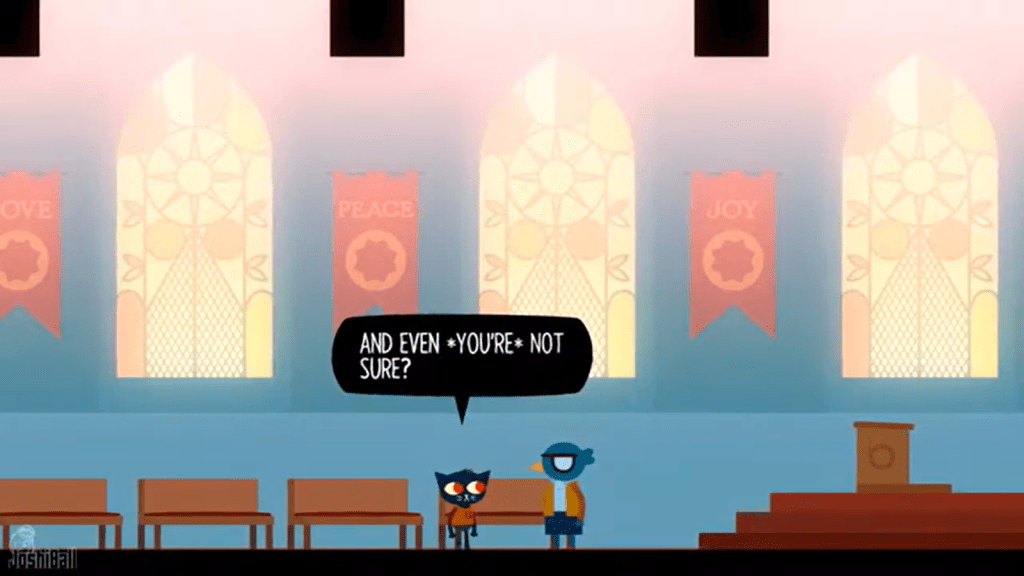
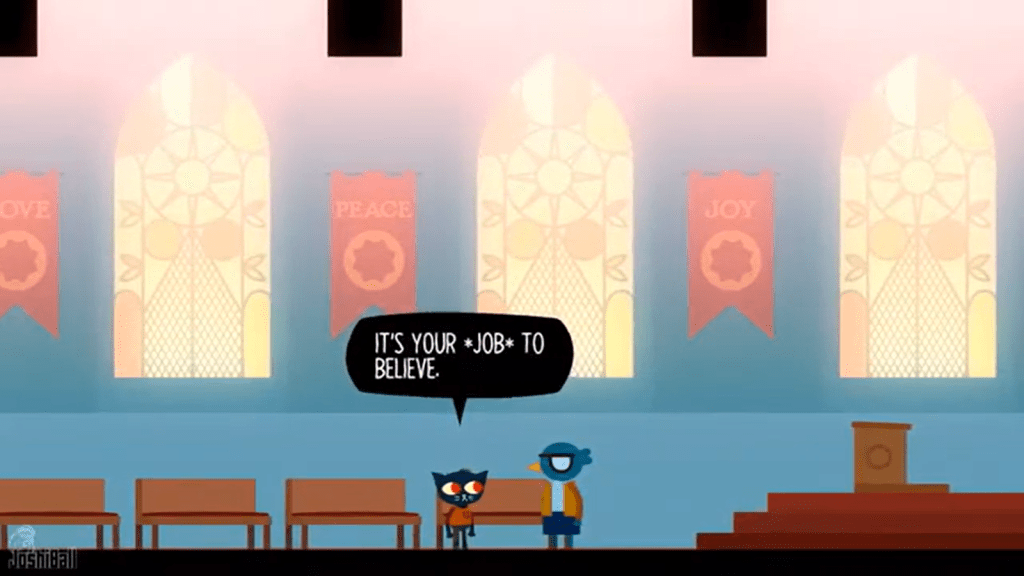
But the pastor retorts with what she believes her job really entails. But Mae still thinks that it’s wrong to lie to people.
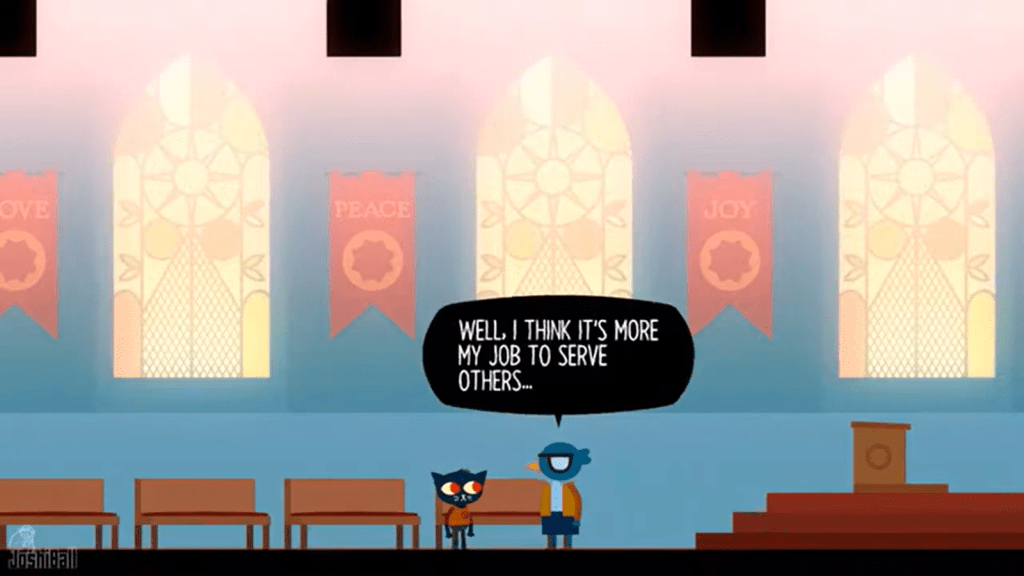

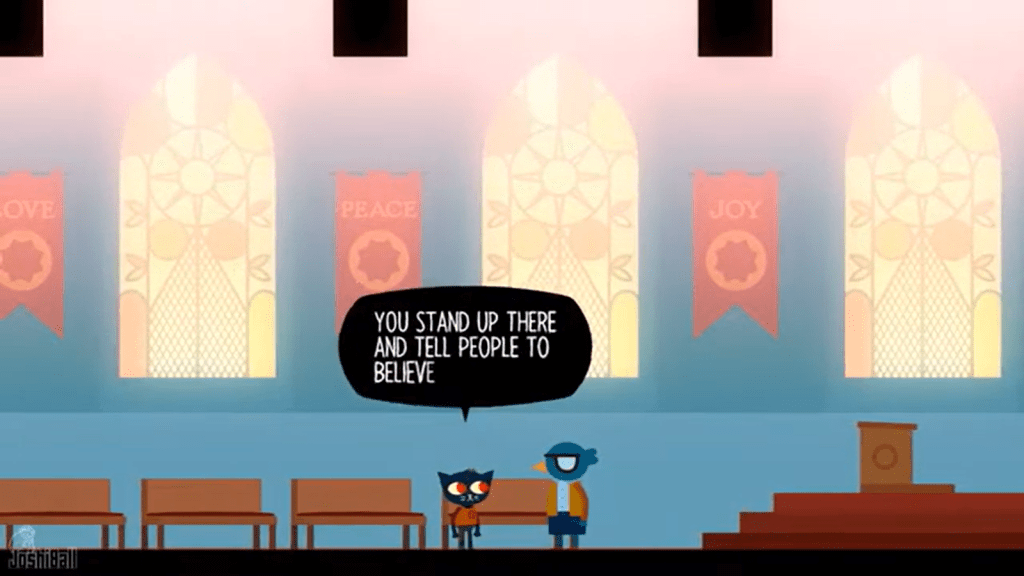
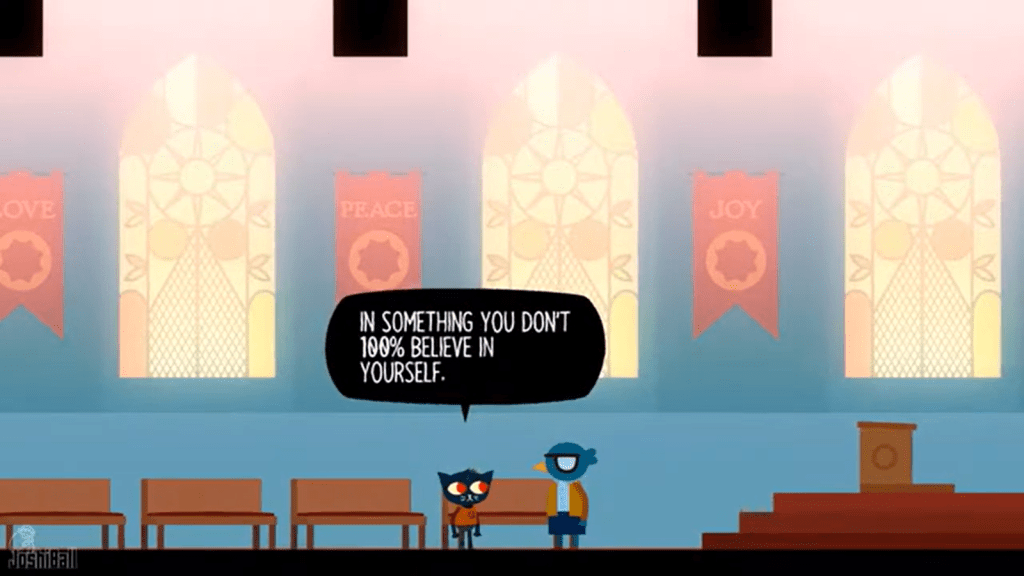
But the pastor responds with the best possible answer to the problem: If she chooses to do nothing, who WILL it help?
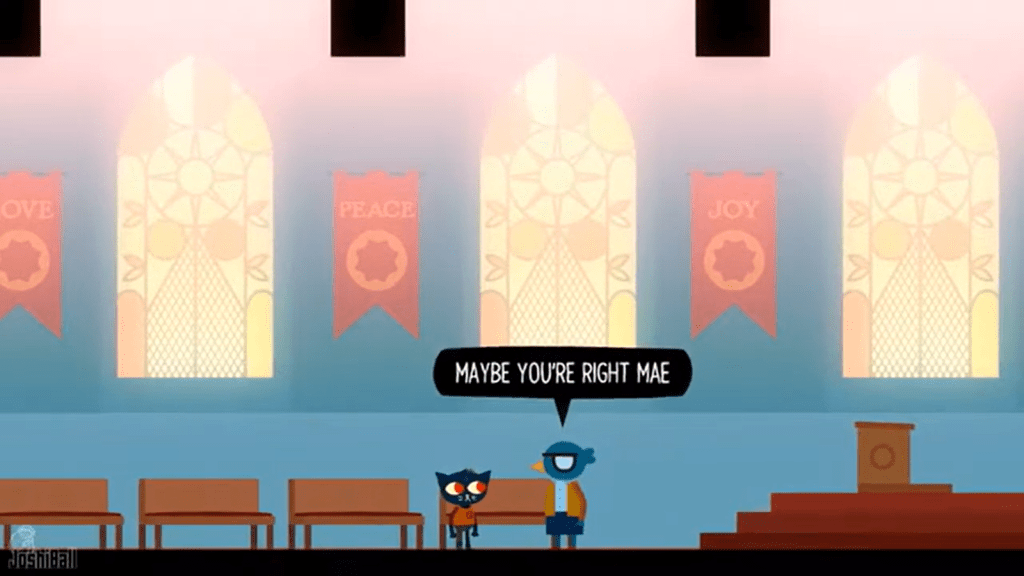
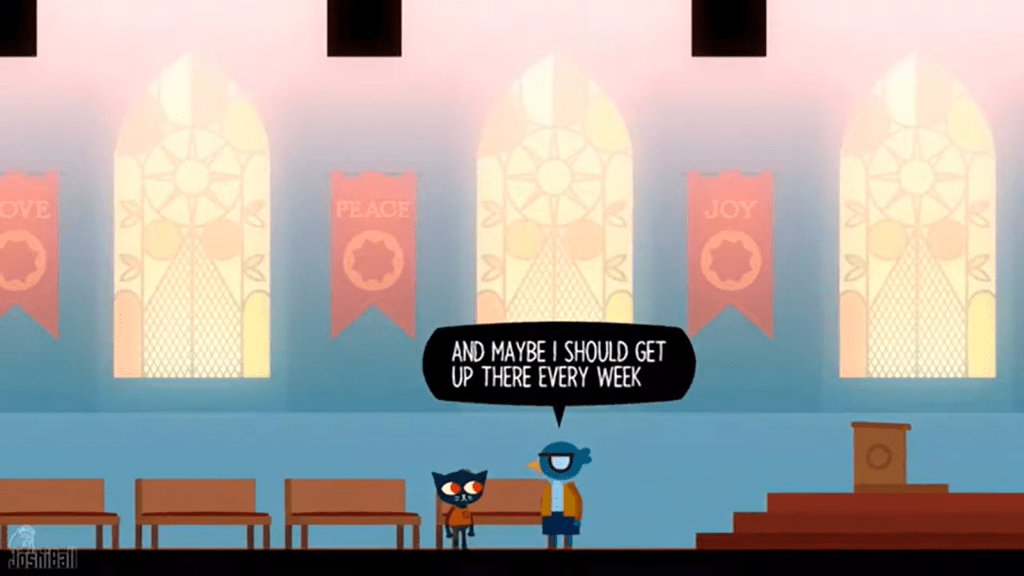

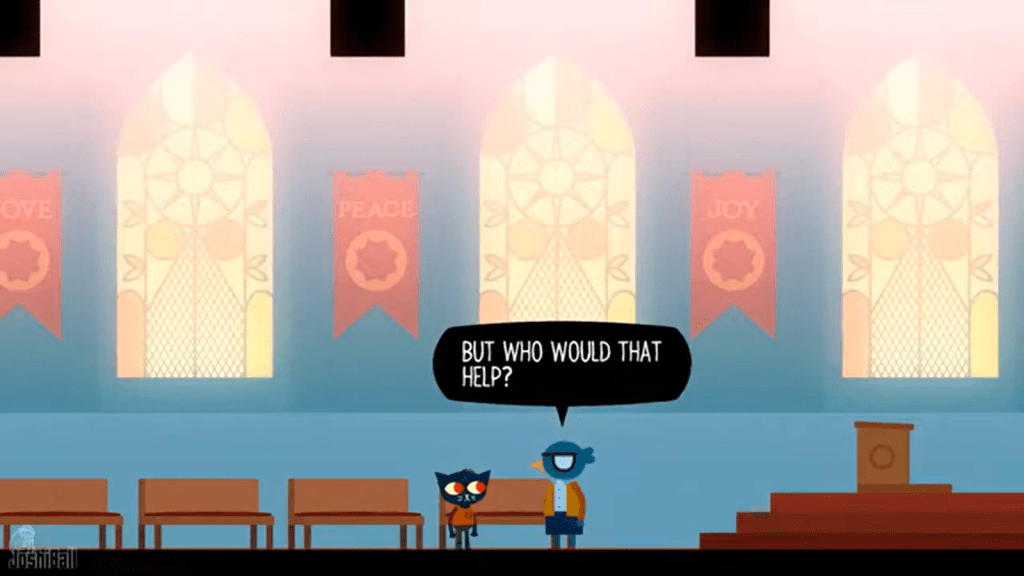
And that addresses the main reason why religion is still around/why people still believe in it, because a lot of lives are tied to it. Churches can do good for communities, organizing food pantries and providing sanctuary to those less fortunate. And to some, religion can be a form of comfort in their darkest hours, helping them remain steadfast in their resolve through the myriad of problems that they face. So the answer isn’t entirely black and white as it would seem. But there are those that use belief as another weapon in their arsenal to justify their behaviors, like we see with the cult in the game. They mention going to the church in the vain hope that it would solve their problem. But when that didn’t work, they resorted to answering the call of the “god” in the pit, sacrificing people to satiate it in the hopes that it solves the lack of economic structure in the town, in very much the same way ancient civilizations used human sacrifice to help their societies. But ultimately that wasn’t really accomplishing anything, a deity isn’t going to give you riches just because you offered it 15 human hearts. NITW seems to make it ambiguous whether or not the events in the mine had any impact on the economy (for better or for worse) but I like that they left it open to interpretation. But maybe perhaps Mae grew tired of the complicated belief system and elected to go on and do crimes, eventually settling in a metro station with other black cats. Perhaps another game tells that tale.
Rodent Quota
Before I end this review with the verdict, it is imperative that I answer the ever-present question of whether or not this game fulfills the rodent quota. Since inception of the game trade, both me and Mr. Cosmia judge a game based on whether or not there are any rodents in it. Said rodents can be anthropomorphic or not, and aren’t limited to just rats or mice, they can be beavers, capybaras, kangaroo rats, etc. So long as the base design is inspired by a rodent, it counts. This portion originates from an in-joke that began with the Persona 5/Kingdom Hearts game trade in which both games had rodent representation, and has gone on ever since. So does this game fulfil the quota?
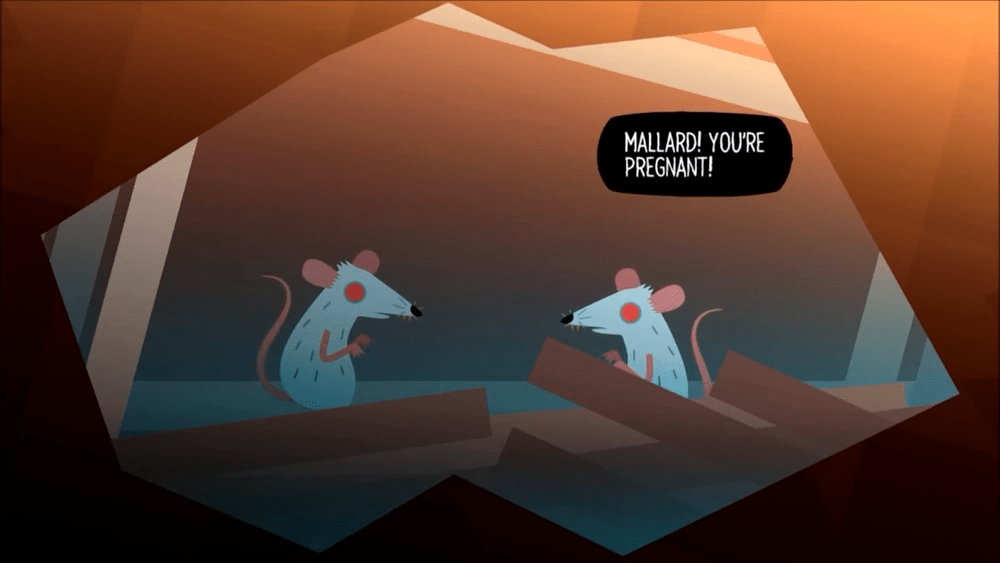
Yes it does, Both anthropomorphic and regular rodents make appearances in this game. Some feral rats are found within an old parade float by Mae that she can feed pretzels to, and there are plenty of rodent citizens Mae can meet in her journey. So this game passes the rodent quota.
The Verdict
Night in the Woods is a simple game with a lot to offer for those who enjoy speculating and theorizing games. The numerous choices and dialogue options ensure that each playthrough can have some deviation each time to break up the repetitive nature that certain games fall into. Compared to other games that were options for me to play and review, this was a refreshing change of pace. No hard bosses like a FromSoft, nor complicated themes like Zero Escape had, just a story about a college dropout finding her way in the world. And ultimately, that’s all you need sometimes. I give this game a 10/10, for being a pleasant experience devoid of difficulty.
Wait what? I forgot to mention the Demontower game? Really?
*checks through the previous sections*
Son of a gun I did, guess I’ll mention it here as it is a part of the whole experience….
Andddd I can’t beat it. I really can’t. Demontower is a game within the game that you can play, where the goal is to get through the tower and defeat the final boss at the top. It’s a simple 2D roguelike dungeon crawler with limited gameplay to it in reference to early videogames of the same genre. In the game, you have two (technically 3) actions: dashing and slashing. The dash allows you to swiftly move over obstacles and dodge hits from enemies, while the slash deals damage to your enemies. The two can be combined for a dashing slash that does both, but it requires the right set up and timing. The difficulty increases as you progress through the tower, with each boss slain you gain a dash added to your meter (depicted as the blue bar below your health in the upper left). However, each boss slain also reduces your health by one, and the enemies get faster and stornger the further you go. This creates an interesting mindset; is it better to play it safe and evade most attacks? or do I want to rush in and hopefully kill the boss before I am killed? This mindset rang through my head as I played and let me tell you, it wasn’t enough.
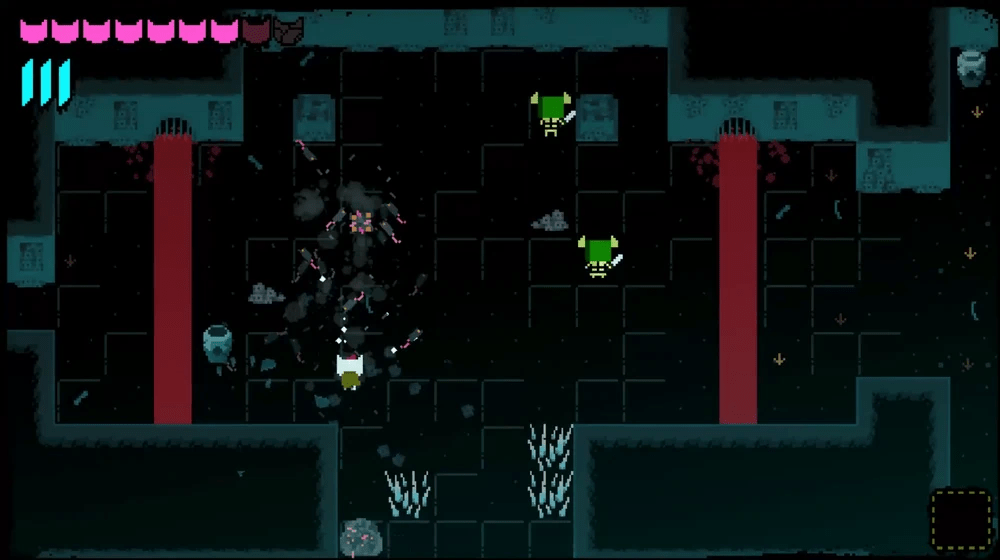
I was not able to beat this minigame no matter how hard I tried. This simple 2D game bested me when I have triumphed over innumerable difficult bosses in my years as a game. Because this is largely optional content, i’ll only dock .2 off of the score. So ultimately this game gets a 9.8 out of 10.
 Cosmia
One response to “Game trade review: A Night In the Woods”
[…] people who committed the same act. It was one of four blog posts I published on this site all year, along with another one by my good friend Spartan. I went into this year hoping I’d average at least one blog post a month at least. Guess […]
LikeLike