
Aaron Bushnell lit himself on fire and then shouted, “Free Palestine!” until he no longer could. At the time of this blog post’s release it has been a month since it happened. He went ablaze and subsequently died on February 25th, 2024. Since then plenty of people have came to their own conclusions about what to make of it. Is he just a crazy dude whose actions should be ignored, lest some other unfortunate soul tries to replicate him? Is he a hero who put his life on the line to protest atrocities? Is he a secret third thing?
Regardless of the answer, it’s worth noting that he is far from the first person to die in this manner. He almost certainly won’t be the last. Self-immolation is one of if not the most painful ways to die possible, yet it keeps on happening. How do we make sense of that? This blog post is dedicated to pondering the significance of Aaron Bushnell’s final act and other similar incidents. In my view self-immolation is neither exclusively a political act nor merely a reflection of poor mental health. By the end of this post we’ll come closer to figuring out what concoction of factors that secret third thing contains.
If it wasn’t already obvious there will be discussions of self harm, suicide, and other unpleasant topics ahead. If that’s going to be a problem for you I’d advise against continuing. If you are someone personally considering ending your life using this method or any other, please don’t. Seriously. I am exploring this topic because I find it noteworthy, not because I condone it. I will explain my reasoning in greater depth later on, but I figure it’s important to be clear on that point now. There may be power in a dramatic death, but doing so locks out the enormous potential of a continued life.
I’d also like to clarify my position in writing about this. I am not a journalist, nor a psychologist. I am a 25 year old whose educational background has limited direct relevance to this topic. I believe all the information I present here to be truthful to the best of my knowledge. I have probably done more reading and thinking about this topic than the average person, but ultimately I’m just a guy who pays to keep his blog on the internet. I presently make negative money on this venture. I’d be happy if you considered my words, but do not take them as gospel. I’m just here to put thought on digital paper. I’ll do my best to link my sources throughout, but if you want true academic rigour look elsewhere. Nevertheless, I feel it is important to get these thoughts out while the moment’s still somewhat fresh. With all of those clarifications out of the way, let’s get into it.
Aaron Bushnell

This man ensured that his self-immolation was livestreamed. He did not rely on the chance of a passerby recording it. He sent links to his livestream to media outlets. He wore his military fatigues during the act; knowing full well that wearing that uniform while engaging in political protest is prohibited. Guess he can’t get punished for it now. Based on these details among others I am going to make two claims I am confident in: Aaron Bushnell wanted his death to be seen, and he planned out how it would be presented. The contents of his last video are by and large premeditated choices. The biggest exception being the reactions of other people on the scene. To support these claims I will analyze his live stream in greater detail. I will not link his video here, but I am sure you can find it for yourself if you want to. Be warned, you can never unwatch it.
It begins with Aaron standing up after starting the recording. The livestream is shot in portrait mode. Even as someone who strongly prefers landscape videos I can understand the practical advantages of this decision. It is easier to keep himself in frame while walking in this mode. More importantly portrait mode videos are optimized for being viewed on phones (read: how the majority of people will see the video). Whether we like it or not portrait videos are the best option for social media reach today. So that’s what he did. He held the camera in his right hand as he walked. He held a steel water bottle with a missing cap in his left. He starts out by saying the following:
It’s Aaron Bushnell. I am an active duty member of the United States Air Force. And I will no longer be complicit in genocide. I am about to engage in an extreme act of protest. But compared to what people have been experiencing in Palestine at the hands of their colonizers—it’s not extreme at all. This is what our ruling class has decided will be normal.
–Aaron Bushnell, February 25, 2024
After saying these words he walks in silence towards the entrance of the Israeli Embassy in Washington D.C. All we can hear during this time are his breaths and the sound of his movement. We can only wonder what was going through his head during this time. It was his last chance to reflect. Did he have any second thoughts about what he was about to do? Whatever went on in his mind evidently did not shake his resolve to proceed. His silence afterwards underscores the importance of his opening. His opener was likely drafted in advance. Quite possibly rehearsed. He could have kept talking off the cuff while he walked, further explaining his reasoning for protesting the genocide. He could have discussed other relevant issues along the way. He chose not to.
He had a concise message, only 67 words. This blog post exceeded that mark before the first paragraph was over. Perhaps he thought saying anything more before the fire would muddle his message. Whether or not that guess is on the mark, the on-screen effect is powerful. When the few words he did say are juxtaposed with the ensuing silence they appear more important. He gives the audience time to think about the words and wonder what he’s about to do. Where is he going? What’s in the bottle? He doesn’t directly tell us either of those things, but we can see for ourselves soon enough. He only says what can’t be shown through physical action alone.
He begins by identifying himself, letting his name be known. This in itself is notable. One could argue that starting with his name is an ego trip. That he first and foremost wants to be remembered himself. That’s an overly uncharitable interpretation in my view, but he did want his name remembered. While his reason for doing so probably had self-serving components, it was also the practical move. Aaron Bushnell was not the first person to self-immolate in protest of the war in Gaza. That title goes to an unnamed woman in Atlanta. She set herself on fire in front of the Israeli Consulate on December 1st, 2023. She was carrying a Palestinian flag. She was not recorded. We do not know her name. As far as I know she is still being treated for her burns. The only reason I’m aware of her at all is because it occasionally comes up in discussions about Aaron Bushnell.
While many of us haven’t heard of the unnamed woman from Atlanta before February 25th, I strongly suspect Aaron Bushnell had. Her self-immolation did not make waves. The genocide continues unabated. Most people would take that as a sign that self-immolation doesn’t work. Aaron Bushnell (probably) took that as a sign that he should make his self-immolation harder to ignore. So unlike her he recorded his actions. He chose a more prominent location. And he mentioned his name before anything else. With his name spread far the ideas associated with him can spread further.
As an aside, I’d like to point out a quote I found in the article linked above pertaining to the unnamed Atlanta woman.
We are saddened to learn of the self-immolation at the entrance to the office building. It is tragic to see the hate and incitement toward Israel expressed in such a horrific way. The sanctity of life is our highest value.
Anat Sultan-Dadon, consul general of Israel to the southeastern U.S.
If the sanctity of life is your highest value, how does that apply to Gaza? I’m not seeing much care for the lives of Palestinians there. I’ve seen a child’s corpse carried in a plastic bag. I’ve seen hundreds of Palestinians shot down as they rush to get food. Where’s the sanctity? Are they sub-humans that the sanctity of life does not apply to? Are your values so weak that even your highest value is negotiable? Or are you simply lying to diminish her protest? The consul general’s statement laments her actions while dismissing her message. Granted, it’s easy to misrepresent her message when it’s somewhat vague in the first place. Burning with a Palestinian flag in front of an Israeli office building does say something about the conflict. However, it leaves plenty of ambiguity. There’s less to be found in Bushnell’s approach.
Now on to sentence two, we’re making great progress! Aaron Bushnell identifies himself as part of the Air Force. He’s part of the military and he wants his audience to be keenly aware of that. This fact alone has sparked controversy online. There’s a portion of people on the left who thinks anyone and everyone serving in the US military are reprehensible. Soldiers are the ones making all the war stuff America does happen, pretty fucked up. I see their point to an extent, but I can’t agree to dismissing them completely. We’ve all made some questionable decisions when we were in our late teens/early twenties. Admittedly not everyone has made choices so consequential. However, considering our country’s culture of valorizing the position and incentivizing poor people to join I can understand why people get sucked in. In this case Aaron Bushnell seems to have become disillusioned with his role in the military. He didn’t have long before he could get out, but there’s some things you can only do while you’re still in.
Aaron Bushnell implicates both himself and the American military in the genocide of Gaza. If being a cybersecurity guy in the Air Force makes you complicit, that can apply to plenty of others as well. The footage and images we can find on social media paint a grim picture. I can only imagine what horrifying imagery he’s seen as someone with access to more info. Whatever he saw must have left a huge impression on him. For those still reading to this point but don’t believe the Israeli force’s actions constitute genocide… really? Yeah the IDF’s just doing plain old war with Hamas, just normal war stuff. Not every war’s a genocide y’know. They just happened to kill over 10,000 children in the process. Woops! No possible way to avoid that happening! Hamas guys might’ve been hiding behind those kids, so we gotta shoot through them. Either the IDF’s malicious in how many civilians they’ve killed or incompetent. Probably both honestly. Even if the wide scale destruction of Gaza somehow doesn’t constitute genocide, it’s still wrong.
He frames his imminent self-immolation as an “extreme act of protest.” He’s now part of a long history of people burning themselves for similar reasons. The most famous example being the Vietnamese Buddhist monk Thích Quảng Đức. He protested the oppression of Buddhists under the Western-backed South Vietnamese government. The photos of his self-immolation spread far and wide, remembered long after. Just look at Rage Against the Machine’s debut album, or what Aaron Bushnell did. If Thích Quảng Đức never set himself on fire would Aaron Bushnell still be alive? Hard to say for sure. I will explore the history of self-immolation as protest further later. At this point I’ll just say the following: you can argue about whether the act counts as legitimate protest or just a flashy suicide. It’s undeniable that there’s a strong precedent of self-immolation being perceived as protest. Aaron Bushnell was aware of that precedent and deliberately chose to become a part of it. There’s plenty of room to argue about its effectiveness, there’s no room to argue about his intent. He made himself clear.
He argues the extremity of his act is dwarfed by the sheer scale of the death and destruction found in Gaza. What’s the deliberate end of one life compared to 30,000 and counting? Just because Palestinian’s treatment has been normalized does not mean it’s anywhere near normal. I’d also like to call attention to Bushnell’s use of the term colonizers. Presumably he’s using that term to refer to Israel and those actively supporting its violence. Using that term says a lot about how he feels about Israel. It also connects to one of his most controversial comments, which he made on his Reddit account. Let’s address that now.
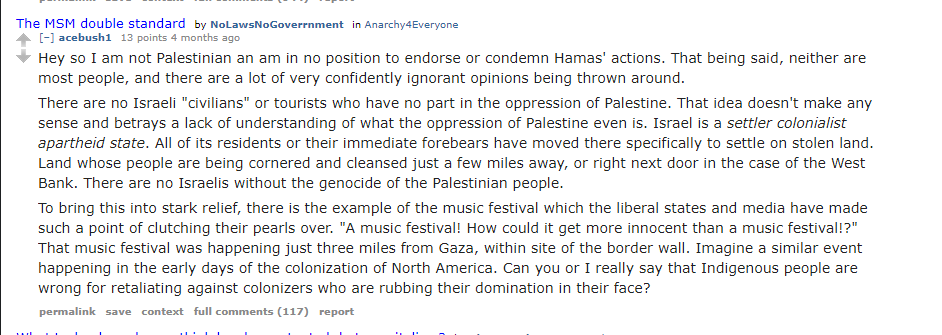
Here I am, writing extensively about a guy who wrote this. I wouldn’t be surprised if this bites me in the ass later. Oh well, guess I can’t expect the guy who set himself ablaze to always be on point with his takes. While this comment doesn’t outright endorse the October 7th attack it comes far too close to comfort for many people, me included. I feel it’s important for me to be clear here. I am not writing about Aaron Bushnell because I agree with everything he’s said or done. I find him interesting, I share his desire for Palestinian liberation, and I think there’s plenty to learn from him. I’ll even admit I find some of his words inspiring. Not these words specifically.
Frankly I find his comment above frustrating. He makes some valid points, but the wrong parts are fatal. Israel cannot exist as a predominantly Jewish nation without subjugating Palestinians. That much is true. Having a fun music festival so close to Gaza is tacky at best to put it nicely. I won’t say the festival goers deserved what they got. They didn’t. It is a pretty fucked up place to hold a festival though. What I take issue with is his implication that there are no Israeli civilians.
To my eyes that’s not far off from the logic some Israelis use to say there’s no civilians in Gaza. People in Israel may have some degree of complicity with their government’s atrocities, but they are not equally responsible. Not everyone there agrees with how the Palestinians are treated, though a depressingly large number do. Not everyone has much say in the matter at all. Targeting IDF soldiers is one thing, but targeting random people in the area is another. Do Israeli civilians have some degree of complicity in Palestinian oppression? Sure. But that doesn’t mean collective punishment is fine, actually. It’s fucked up when Israel does it, and it’s fucked up when Hamas does it too. I’m not a fan of mass killings in any form. By implying Israeli civilians can be legitimate targets he makes the rest of his message a lot easier for skeptics to dismiss.
We can scrutinize Aaron Bushnell’s past comments and actions all day. Search for something objectionable and you’ll probably find it. What are we accomplishing by doing that? It seems to me like a lot of people want to say, “Oh he said/did X therefore I can safely ignore him.” It’s not far off from how people justify prominent cases of police violence. Oh he did some crimes before, totally deserved. Oh he had a drug problem, death penalty approved. Does any of that *actually* have to do with the problem at hand? Maybe a bit, but most of the time it’s just character assassination and post hoc rationalization. I may take issue with his Reddit comment, but he didn’t say any of that shit in his final video. His past is important context, but did you know about that before he live-streamed his demise? Probably not. If you have a problem with the message in the video engage with that message specifically.
With that tangent out of the way, it’s finally time to talk about the most intense part of the video. The part the powers that be decided will be normal. Once Aaron reaches the gated entrance of the Israeli embassy he sets his phone down on the ground to continue recording. Doing this allows his full body to be in view for what comes next. It also ensures his phone doesn’t get broken part way through the live stream. As he sets the phone down we get a good view of his insulated steel water bottle. Considering the stickers this is likely a personal bottle he’s had for a while. It used to contain the liquid that brought him life. On February 25th, 2024 it contained his demise.
He walks away from the camera towards the gates. At this angle we can see the gates far more prominently than the building behind it. He likely wanted to remind people of the gates around Gaza. Eventually he stops and turns around. At this point he swiftly pours the unidentified contents of his water bottle over his hair. He promptly puts his hat back over his head. He tosses his bottle to the side, sparing it from the flames. He takes a deep breath that sounds like a sigh. He could have stopped himself at any point until now, but the point of no return soon approaches. He pulls out his lighter and says “free Palestine.” When he tries to light himself it doesn’t work right away. He could’ve taken the finnicky lighter as a sign to stop, but he kept going.
We hear the voice of a man from off-screen say, “Hi sir, can I help you?” Aaron completely ignores him, continuing to diligently work his lighter. Impressively, it only takes roughly 10 seconds for it to work. That’s a premium lighter for you folks! Shame we don’t know what brand he used. Jokes aside, this sequence of events puts his determination on full display. The only sign of hesitation he shows is that heavy breath. He tries to set himself on fire as quickly as possible. There were people coming his way and he made sure they couldn’t stop him.
Once Aaron is ablaze, he roars “Free Palestine!” This is not the first time he says those words in the video, but it is certainly the loudest. He channels his pain and anguish into his voice. He screams in agony before managing to force out one last “Free Palestine!” He shouted those words as many times as he could. Meanwhile police and paramedics approach the scene. While Aaron Bushnell calls for a free Palestine they tell him to get on the ground. He ignores them and stays standing. This only lasts so long, he collapses when the flames overtake him.
After Aaron Bushnell hits the ground the first responders appear on screen. The first one on the scene is a paramedic wielding a fire extinguisher. He calls for a fire extinguisher, anticipating that the one he’s holding will not be enough. Another man enters view pointing a gun at Aaron Bushnell. I’ve heard mixed reports about what his position is, but to the best of my knowledge he’s a member of the Secret Service. Regardless he’s a guy whose job involves carrying a gun around, and he certainly makes use of it. Can’t be too careful around a half-dead charred body.
While other people work to put the fire out the man he keeps his gun pointed. At one point a paramedic straight up says, “I don’t need guns, I need fire extinguishers!” Couldn’t say it better myself. This is a man on fire collapsed on the concrete. What danger is that gun preventing? Yet he keeps the gun aimed on Bushnell the entire video. To the guy’s credit he does raise his gun when one of the other responders steps in front of it. He changes position so he can safely keep his gun on Aaron. How considerate. I really can’t blame the Secret Service guy too much. Cops are trained to handle threats with guns. Aaron Bushnell’s ideology threatens his employment. Ultimately the Secrete Service guy’s actions worked to Bushnell’s advantage. He got to make federal law enforcement look bad on camera for the world to see. The video makes them seem trigger happy and unhelpful. All the cop had to do was be himself.
The video ends when someone finally notices the phone. He calls attention to it and promptly shuts the recording off. It was a good time to end regardless. It’s a mere stroke of luck that nobody noticed it earlier on. Aaron got to say his piece, and we got to see the first responders inadvertently contribute to the message. It only ended after the fire was out. Soon afterwards they got Aaron Bushnell to a hospital. Unlike the woman in Atlanta they were too late. He was 25 years old.
The thought occurred to me that I am breaking down Aaron Bushnell’s last video as if it were a film course essay. Is it really right to analyze a man’s death in such a fashion? In most cases it definitely wouldn’t, but Aaron Bushnell’s a unique case. The closer I examine his video the more evidence of deliberate planning I see. I can say with near certainty that he chose all of his words and most of his actions ahead of time. He set up his phone so that it would record upright uninterrupted. He framed his video in a manner well-suited for social media. It is highly unlikely the recording would have gone as smoothly without that preparation. Aaron Bushnell put plenty of thought into making his self-immolation as impactful as possible. He did so with a live video directed and starring himself. Up until he set himself on fire he left nothing to chance.
To be clear I don’t think Aaron Bushnell had any formal training as a videographer. Instead I suspect he simply had good intuition and did some research during his preparation. Thích Quảng Đức’s self-immolation is world famous primarily because it was photographed. The photographs are high quality and urge all who see them to confront their implications. However, those photographs were taken in 1963. Photography still lives on presently, but it doesn’t quite have the same reach it used to. Some people may even think it’s AI-generated. If there’s a medium well suited for wide reach today it’s a short video spread through social media. That’s exactly what Aaron Bushnell made. No matter how the presses cover his death they can’t change the content of the video itself. His words have spread across the world.
The Aftermath
At the time I’m writing this little has changed on the ground in Gaza. People are starving to death and a ceasefire still seems distant. Whatever effects Aaron Bushnell’s death may have, it clearly did not result in Palestine’s immediate liberation. Does that mean it was pointless? Did he set himself on fire for nothing? Is this just the useless actions of a mentally disturbed individual? There are some people that would simply say yes to all three questions. This position is hard to disprove. Even if there comes a time when Palestinians are free how are we supposed to measure Aaron Bushnell’s contribution? Self-immolation as protest only has power if it affects the people that continue living. To my eyes it clearly had some effect on some people. The long term implications remain to be seen.
His self-immolation spread like wildfire on my corner of ex-Twitter. The Discourse was inescapable for days afterwards. I presume his reach was comparable on other social media platforms. He indisputably got people talking, both about him and the cause he died for. A good chunk of that talk was complete nonsense, but still. It’s worth noting that the war in Gaza has been a hot button issue since it started. I think most people are aware of it to some degree. I doubt Aaron Bushnell’s self-immolation dramatically changed many people’s minds on the subject. From what I’ve seen people’s takes on his death correlate quite strongly with their pre-existing views of the conflict. The biggest change I’ve noticed is that it galvanized Pro-Palestine people to a significant degree. Public pressure for a ceasefire continues to grow. It seems like burning Aaron Bushnell helped fuel that activism. That counts for something. Does it count for enough to be worth the sacrifice? That’s harder to say.
Before he marched to his death Aaron Bushnell posted the following on Facebook:
Many of us like to ask ourselves, ‘What would I do if I was alive during slavery? Or the Jim Crow South? Or apartheid? What would I do if my country was committing genocide?’ The answer is, you’re doing it. Right now.
There are many terrible things humanity has done that we’ve kept to the past. The specters of their legacies live on, but those specific injustices are done. Unfortunately, we are not as far away from them as we’d like to think. There’s an atrocity going on right now, and we have not done enough to stop it. Obviously some people share more blame than others. The people with the most power to change things in Gaza are perpetuating war. I think that can change with enough public pressure. We haven’t gotten there yet.
So I ask myself, what am I doing to bring this genocide to an end? It is true that I’m in no position to change things alone, but am I even doing my part? I sometimes like and retweet pro-Palestine posts, marginally boosting their visibility. I’ve sent some money Palestine’s way, but not that much. I can’t even say for sure if those funds actually reached people on the ground. There’s only so much I can do alone, but I haven’t tried too hard. That’s a weakness I recognize in myself. I see writing this blog post as an important step, but surely there must be more beyond it.
Besides the obvious I think the message Aaron Bushnell tried to send is that we’re too complacent. Aaron Bushnell was an attractive young white man with a promising future. He was going to leave the military soon, and he wanted to pursue a career in software development afterwards. He had a wealth of opportunity for a peaceful, successful, and happy life. The same could not be said for the people in Gaza right now. He can choose to die the way he did. Most people in Gaza probably can’t access the necessary materials to self-immolate. Is that stark difference in opportunity really okay? Absolutely not. Still that wrong is righted by uplifting the Palestinian people, not tearing another man down. However, if doing so brings Palestinians closer to liberation, there could be some value to it. Probably less value than he could bring to the world with his continued existence, but value nevertheless.
We can only speculate Aaron Bushnell could accomplish had he continued living. Maybe he could help people with software engineering money. Perhaps he could’ve used his tech skills to support a cause. However, all that untapped potential does nothing to save Palestinians suffering today. As long as the war continues more lives will be lost. More children will have their futures snuffed out. Aaron Bushnell was distinctly aware of this problem.
He could play the long game and help deal with tomorrow’s challenges. Addressing the problems of today require something more drastic and immediate. I think this is the crux of why Aaron Bushnell chose to self-immolate. He may not have lived out his full potential, but he had something to work with already. He possessed the appearance of an attractive white male in the military. One of the most widely respected and/or feared things a person can be. The optics of burning that away can be shocking. It certainly got more attention than a conventional protest would have. So he harnessed those optics to the best of his ability to hasten the end of the genocide. Admittedly it’s still going on, but the pressure to end it continues. When it inevitably does end will we be able to tell how much Aaron Bushnell contributed? Perhaps without his death it would end days or weeks later. If that’s the case, his death would save some Palestinian lives. I don’t think that’s possible to prove either way. Can we definitively say Aaron Bushnell’s death had meaning? Not yet and maybe not ever. Regardless, the collective action of the living can make his dying wish a reality.
Self-Immolation: Political Act or Mental Health Problem?
It should be clear by now that I view Aaron Bushnell’s death as a political act. That’s how he framed it himself, as “an act of extreme protest.” He acted fully composed on camera up until the fire started. This is a person who wanted to accomplish something utilizing his own life. From all I’ve read about him it seems unlikely he’d kill himself absent the war in Gaza. He had plenty to look forward to and no obvious signs of major mental health problems. No obvious signs besides the fact he set himself on fire any way.
Indeed there is something fundamentally irrational about the act of self-immolation. Even if it’s for a cause it’s still technically suicide. An act that goes against our most base instincts to live, denies our futures, and hurts those who love us. As my therapist aptly put it, it’s an eradication of self. Furthermore, self-immolation is an incredibly painful way to go. You can hear it in Aaron’s voice. Is there any situation where self-immolation is the logical course of action? Probably not. It’s a rare and unusual act that goes against our sensibilities. To go through with it requires a different thought process from the norm. One could argue you have to be mentally ill to self-immolate by definition. Even if that’s your stance, are you really satisfied just leaving it at that? Mental illness is a two word phrase that encompasses a vast expanse of experiences. What can we make of Aaron’s?
Once he died news outlets dug into Aaron’s past in search of context for his actions. You can read the New York Times and Washington Post do just that. In these articles we learn that he grew up on a reclusive Christian commune in Massachusetts. We don’t know what he went through while he was there, but the answer probably isn’t pleasant. How much did his (likely) religious trauma inform his actions? We’ll never know for sure, but it probably played a role. He apparently went from being a highly conservative Christian to an anarchist during his time in the military. Quite the jump.
Based on these articles we see that Aaron Bushnell had a fucked up sheltered childhood. Then he joined the military and went radical in the opposite direction. Truly an unfortunate tale of childhood trauma gripping a man long after he escapes. Real shame it had to end this way. We can just leave it at that, right? Eh…
It is likely the case that Aaron Bushnell’s troubled upbringings contributed to his final decision. His mental health had room for improvement. He lived his life going from one rigid structure to another, disempowered from changing much of anything within them. Perhaps he felt compelled to break free in a drastic way, disempowered to do anything else to help. Truly a tragic end. Sure, but so what? He didn’t kill himself because he was tired of his own life. He did it because he was tired of seeing Palestinians slaughtered. Is his message wrong? Does mental illness preclude you from being right about anything? He still had a stronger grip on reality than those who think Israel’s mass killings are completely fine.
Aaron Bushnell is an exceptional case in many respects. I’m not aware of anyone else live streaming their own self-immolation. His unique background and position as an American soldier also contribute to the intrigue. However, his act of “extreme protest” is not in itself unique. I already mentioned the Buddhist monk from Vietnam, but he’s not the only one that burned themself for that war. For instance Norman Morrison, a Quaker and activist burned himself in front of the Pentagon. He incidentally chose to self-immolate near the Secretary of Defense, Robert McNamara’s window. The incident greatly affected McNamara, eventually leading to a change of heart on the Vietnam War. He resigned from his post a few years later. Self-immolation can move a person in power if they don’t look away. Unfortunately the war continued with or without one Secretary of Defence’s involvement. Self-immolation cannot single handedly end a war. It’s on the living to follow through.
One prominent example of self-immolation having a clear direct impact is that of Mohammed Bouazizi. He was a Tunisian street vendor that set himself ablaze after a dispute with a municipal inspector. His actions are widely viewed as the spark that set off the Tunisian Revolution and subsequent Arab Spring. Barack Obama compared Bouazizi’s action to the Boston Tea Party and Rosa Parks. The effects of his sacrifice still reverberate throughout the region to this day. Granted, it’s probable that the Arab Spring could have emerged some other way given the conditions at the time. The efficacy of that specific movement is also debatable. Sure some repressive regimes were toppled, but it’s not as if widespread healthy democracies took their place. Regardless, the Arab Spring had a major impact on the region. Bouazizi’s death is part of that.
The examples I have discussed so far are unrepresentative of the act as a whole. These are famous instances that appear to have made a political impact to some degree. Most who self-immolate are people you haven’t heard of and never will. They didn’t make the news. Even among the people who do, it’s rare for their deaths to have a major impact. Have you heard of David Buckel or Alan Bruce? They set themselves ablaze to protest climate change four years apart. They got a limited amount of media attention and some articles written about them. I know more about them than I would have if they did not self-immolate. I have gleaned some insights from reading their stories. However, climate change is still happening, and we still aren’t doing enough to address it. They didn’t move the needle too much.
You may notice that most of the examples I’ve given thus far are men. Did this happen because I’m sexist? Perhaps it’s because the men take up the majority of famous examples. I like to think I’m not sexist, so I’ll go with the latter. Remember when I brought up Norman Morrisson? He wasn’t the first to self-immolate to protest the Vietnam War in America. That title goes to Alice Herz. Yet it seems Norman’s self-immolation is more widely known. His choice to self-immolate in front of the Pentagon instead of Detroit could have made the difference. Perhaps his status as a younger man in contrast to the 82 year old Alice Herz contributed. I think it was both.
The male dominance I’ve observed in the headlines about self-immolation is not reflected in the data. It is true that men make up the majority of self-immolations in higher income countries. The reverse is true for lower-income countries. Self-immolation is also a far more common suicide method in lower-income countries. For every Aaron Bushnell there are multiple women lighting themselves on fire to escape their oppressive conditions. The famous examples are more of an exception than a rule.
There is a markedly less famous self-immolation that factors heavily in my mind. That is the death of Westley Banks. He was a college student who went to the University of Illinois at Urbana-Champaign. He self-immolated on the rooftop of the Krannert Center for the Performing Arts on April 19th, 2017. To my knowledge he did not leave a note behind; he simply left his mark on campus. If he wanted to send a message with his death, he left it ambiguous.

I am only aware of Westley Banks because I went to UIUC for grad school. He was already gone a few years before I set foot on campus. I heard about his death via word of mouth. I wondered what this university did to him. I was probably just projecting my own negative feelings towards the place on him. Truthfully I do not know why he did it. I can gather bits and pieces online, but only he knew the full picture. From what little I do know I feel confident saying the following: his self-immolation was not an anti-war protest. He went ablaze to extinguish his life. He did it after 2 AM, a time when people were less likely to witness or stop him. Assuming that death was his goal, he unequivocally accomplished it.
I bring up Westley Banks to keep things in perspective. The typical self-immolation has more in common with Banks than Bushnell. Most self-immolations aren’t recorded, and they aren’t usually meant to serve a specific cause. For many people the choice to self-immolate is not much more than a means to death. Westley Banks probably wanted to convey something with his choice of method and location. He was an artist through and through. It’s plausible that he took inspiration from Thích Quảng Đức and other famous self-immolations in doing so. That being said, his actions weren’t a protest. At least not in the same way Bushnell, Morrisson, Herz, et. al. did it.
So is self-immolation an extreme act of protest or just a mental health problem? The answer is not clear cut. I saw a now-deleted tweet argue that all suicides are political acts. They’re inherently a rejection of the living world; of the life they lead and the society they exist within. I’m inclined to agree with that argument. Yet even if we grant that premise some suicides are more explicitly politically motivated than others. Aaron Bushnell chose self-immolation so his message would have as strong an impact as possible. Others may simply choose the method for its high mortality rate. The intentions going into self-immolation vary by individual. There are common threads, but there is no single unified meaning to the act. There’s a unique story behind every single person that has done it.
Conclusion
One thing all self-immolations have in common is being a tragedy. Nobody should have to go out that way. Its causes are tragedies in themselves. These are by and large decent people dying painfully for preventable reasons. The more I learn about the people who chose this ending, the more I see their humanity. Alice Herz was a German of Jewish descent, she escaped Germany with her daughter when Hitler rose to power. She had the foresight to see the brutality that would come her way if she stayed. She made her way to America during the war. Here she was protected from the largest genocide known to man. In her later years she watched the country that sheltered her enact large scale atrocities of its own. She vigorously protested the Vietnam War. She marched for the civil rights movement too. She openly wondered what else she could do. She was the type of person we should have listened to the most, but reality worked differently. She decided fire would make her voice reach further. To a certain extent she was right.
Alice Herz died before my parents were born yet I know her name today. I am far from alone in this fact. It is almost guaranteed that would not be the case if she hadn’t self-immolated. I would not know of Aaron Bushnell, or any similar case I’ve mentioned either. They leveraged their lives to spread their words, and it worked to some extent. The problem is they can’t control what people do with it. Many people don’t care at all. Not everyone who cares to some degree will take action. Plenty don’t even notice it happened at all. There are specific cases where a self-immolation had some impact, but it’s not common. Even when they are influential, that influence includes inspiring other people to do it. Thích Quảng Đức saved lives. He also made more charred corpses. I believe both are true, but I’ve seen more evidence for the latter. Self-immolation isn’t guaranteed to save a single life. It has a much higher chance of ending one.
With an extinguished life comes an end to everything else one could do. I discovered Westley Banks’ music during the process of writing this. I generally don’t seek out this sort of ambient sound, but I’m glad I found this one. There’s an inherent melancholy to listening to someone who committed suicide’s music. Is this what life sounded like to them? Yet it’s beautiful all the same. I’m particularly struck by King, his cover of a minute long Karen O song. He transformed it into a haunting eleven minute epic. Who does that? It’s incredible. Truly no one can ever take his place. What would his music sound like seven years later, had he chosen to live? How would his writing and art develop? It’s a shame we’ll never know. A talented young man, lost to the flames. I could say something similar about Aaron Bushnell.
Thankfully Aaron Bushnell has no imitators so far. His sacrifice is more than enough, we don’t need redundancy. The best way to honor him isn’t repeating his actions, but manifesting his last wish. How can we help free Palestine? What can we do to support the people currently suffering in Gaza and bring an end to the war? Fire alone won’t make it happen.
 Cosmia
One response to “Those Who Light Themselves Ablaze”
[…] pretty bad in that macro global events kinda way, but how about for this blog specifically? Well, I wrote a blog reflecting on Aaron Bushnell’s self-immolation and other people who committed t…. It was one of four blog posts I published on this site all year, along with another one by my good […]
LikeLike